

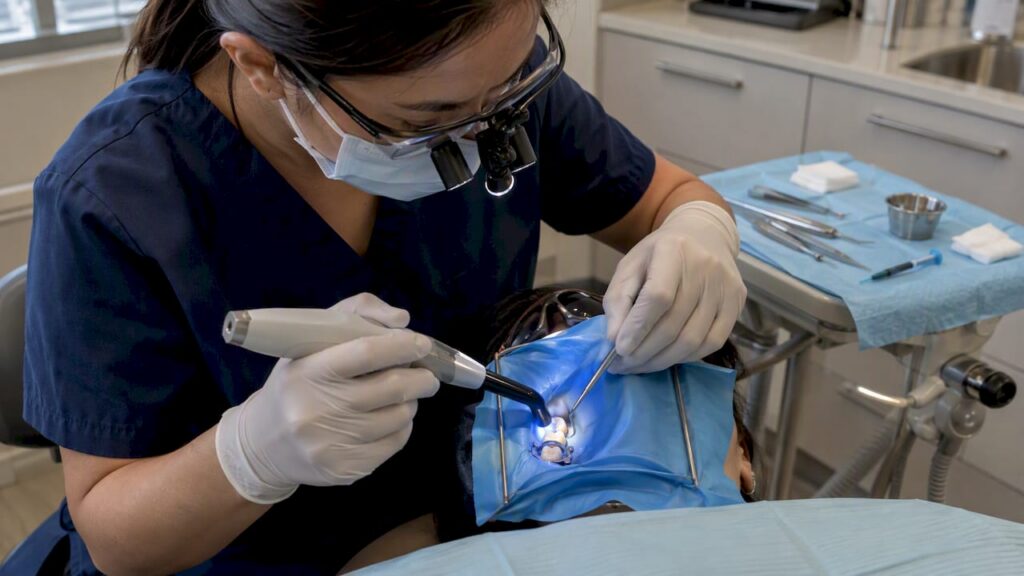
Biomimetic dentistry is a restorative approach that rebuilds damaged teeth using adhesive and bioactive materials designed to mimic the mechanics of natural enamel and dentin, instead of removing more tooth structure than necessary. The main benefit is conservation: less drilling, more preserved tooth, and a lower chance of needing a root canal or full crown down the line. This article walks through the core principles, the materials involved, what the evidence actually supports, and how to tell if the approach fits your situation.
TL;DR:
- Biomimetic dentistry relies on adhesive and bioactive materials that mimic natural tooth mechanics to preserve more healthy tooth structure.
- Immediate dentin sealing enhances bond strength and reduces microleakage, lowering the risk of restoration failure and subsequent root canal need.
- Short-term clinical studies have shown comparable performance among bilayer biomimetic strategies with no fractures or secondary decay over 18 months.
- The approach is most effective on teeth with healthy pulp and sufficient remaining structure, while extensive damage often requires conventional treatments.
- Precise technique and operator skill are critical, and long-term evidence for bioactive materials is still limited, emphasizing the importance of dentist expertise and honest communication.
Table of Contents
- What biomimetic dentistry actually means
- Materials and techniques behind biomimetic restorations
- What the research and ADA guidance actually show
- Who is a good candidate for this approach
- What treatment looks like, from first visit to follow-up
- How Bay Area Dental approaches biomimetic-minded restorative care
- The real tradeoff nobody talks about enough
- Getting started with biomimetic-focused care at Bay Area Dental
- FAQ
- Sources
What biomimetic dentistry actually means
Biomimetic dentistry starts from a simple observation: a healthy tooth is a layered structure where enamel and dentin work together to absorb chewing forces without cracking. Traditional drill-and-fill dentistry often removes healthy tooth structure to create mechanical retention for a filling or crown, which can weaken the tooth over time. Biomimetic techniques aim to rebuild that layered mechanical relationship instead of just plugging a hole.
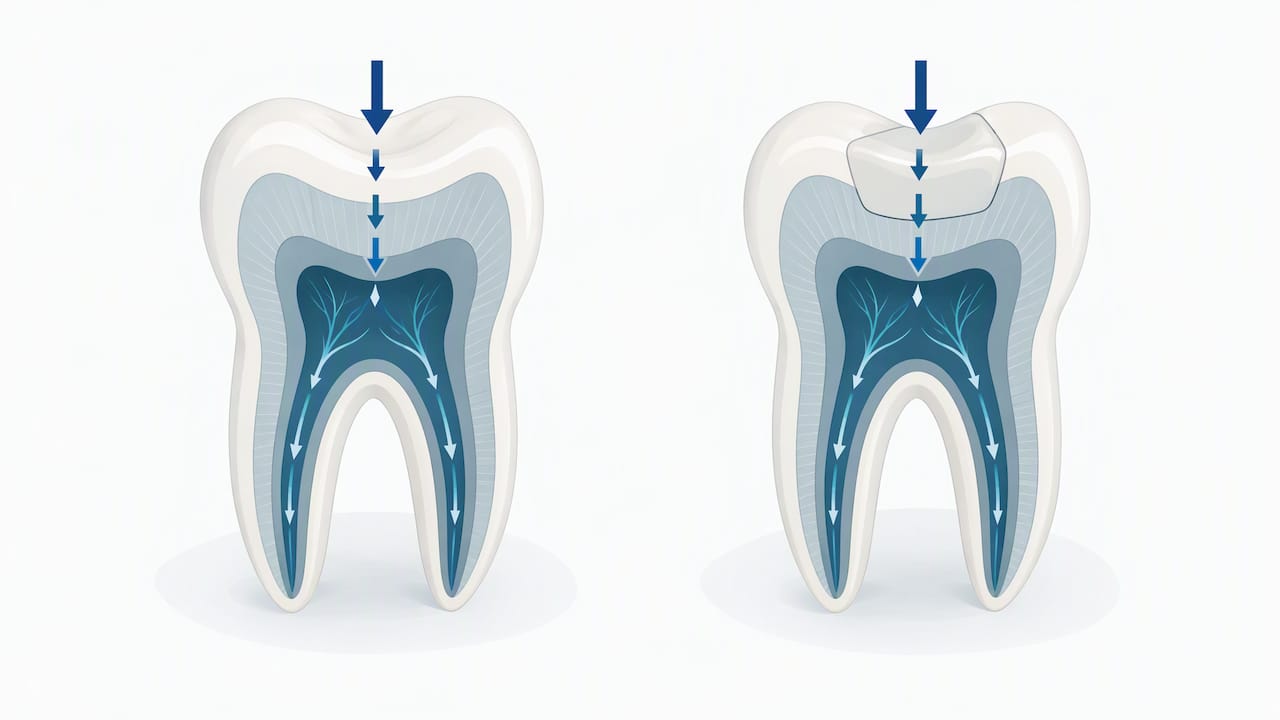
The Academy of Biomimetic Dentistry describes the philosophy as a conservative restorative approach that preserves natural tooth structure and protects pulp vitality by using adhesive materials and techniques that copy the mechanical and biological properties of real teeth. The academy has helped standardize training and protocols for dentists who want to practice this way, though it functions as an educational and advocacy group rather than a regulatory body.
Two clinical strategies sit at the center of the approach:
- Stress-minimizing protocols preserve as much of the original cusp structure as possible and avoid unnecessary beveling, since intact cusps distribute chewing forces more like a natural tooth.
- Bond-maximizing protocols focus on getting the strongest possible adhesive bond between the restoration and the remaining tooth, often through immediate dentin sealing right after a cavity is prepared.
Immediate dentin sealing, or IDS, means applying a bonding agent to freshly cut dentin before any impression or lab work happens, rather than waiting until the final cementation visit. According to the Academy of Biomimetic Dentistry, sealing dentin immediately improves bond strength and reduces microleakage compared to sealing it later, which matters because leakage around a restoration is one of the main reasons fillings and crowns eventually fail.
The practical payoff for patients is pulp protection. Every time a tooth is drilled, there is some risk of irritating or exposing the pulp, the living tissue inside the tooth that can trigger inflammation or infection if damaged. By removing less structure and sealing dentin faster, biomimetic protocols are built to reduce that risk, which in turn reduces the odds that a simple cavity turns into a root canal years later.
Materials and techniques behind biomimetic restorations
The materials used in biomimetic dentistry are chosen because they behave more like natural tooth tissue than older filling materials do. Amalgam and some conventional composites are strong but rigid, which can concentrate stress at the edges of a restoration. Biomimetic materials are layered and flexible in ways that spread load more evenly.
Common materials include:
- Adhesive resin composites bond directly to enamel and dentin and form the base of most direct biomimetic fillings.
- Resin-modified glass ionomer (RMGIC) releases fluoride and bonds chemically to dentin, often used as a base layer under composite.
- Calcium silicate cements, such as Biodentine, are placed near the pulp to encourage a protective dentin-like barrier while sealing the cavity.
- CPP-ACP (casein phosphopeptide-amorphous calcium phosphate) supplies calcium and phosphate ions that can help remineralize weakened enamel and dentin.
- Fiber-reinforced composite bases add tensile strength underneath the visible restoration, acting like a shock absorber.
A peer-reviewed review of biomimetic materials describes how these bioactive options aim to support remineralization and tissue healing rather than simply filling space the way older inert materials did. The review covers mechanisms such as nano-sized amorphous calcium phosphate precursors and protein analogs that help rebuild mineral content inside demineralized dentin, which is a meaningfully different goal than just sealing a hole.
Many biomimetic restorations use a bilayer approach: a supportive base material absorbs chewing stress, and a nanohybrid composite surface layer provides wear resistance and a natural appearance. This mimics how a real tooth works, where dentin flexes slightly and enamel provides a hard, polished outer shell. Getting the thickness and bonding of each layer right is part of what makes the technique more demanding than a single-layer filling.
Technique matters as much as material choice. Dentists practicing this way typically rely on:
- Rubber dam isolation to keep the cavity completely dry during bonding, since moisture contamination weakens adhesive bonds significantly.
- Incremental layering of composite in small amounts, cured in stages, to reduce shrinkage stress.
- Careful occlusal design that respects the tooth’s natural contours instead of flattening them for convenience.
- Finishing and polishing steps that smooth the margins where restoration meets tooth, reducing plaque buildup and future leakage.
Pro Tip: Ask whether your dentist uses a rubber dam for composite fillings. If the answer is no, bond strength and longevity may be compromised regardless of which materials are used.
Clinicians choose between a direct composite filling and an indirect onlay or overlay based on how much tooth structure remains. When enough healthy enamel and dentin are left, a direct composite built up in layers chairside is usually faster and more conservative. When a cusp is fractured or a large portion of the tooth is missing, an indirect onlay made from composite or ceramic, bonded in a separate visit, often holds up better under chewing forces because it is cured and shaped outside the mouth under more controlled conditions. Material choice interacts with longevity here: a well-bonded onlay on a tooth with adequate remaining structure can last many years, while attempting a large direct filling on a severely compromised tooth tends to fail sooner, regardless of how skilled the operator is.
What the research and ADA guidance actually show
The evidence for biomimetic dentistry is genuinely encouraging but still developing, and the strongest support right now comes from a mix of systematic review literature, clinical guidelines, and early trial data rather than decades of long-term outcome studies.
A peer-reviewed review summarizing biomimetic materials and approaches in restorative and regenerative dentistry found that bioactive materials are increasingly used to support remineralization and pulp healing, moving the field away from purely inert fillers. The review also describes biomimetic remineralization techniques, including CPP-ACP and related mineralization gels, as showing laboratory and early clinical promise for rebuilding demineralized enamel and dentin, though it stops short of calling these approaches established standards of care.
On the guideline side, the American Dental Association’s clinical practice guideline on restorative treatments for carious lesions recommends prioritizing selective carious tissue removal over complete removal of all carious dentin in moderate to advanced cavities in vital permanent teeth. That recommendation lines up directly with biomimetic goals: removing less tissue protects pulp vitality and keeps more of the tooth’s original mechanical structure intact. The same guideline calls for shared decision-making, meaning your dentist should walk you through the trade-offs of different approaches rather than defaulting to one method for every case.
Newer trial data adds some short-term support for bilayer biomimetic strategies specifically. A randomized clinical trial following 160 posterior composite restorations across 40 participants over 18 months found comparable clinical performance among several bilayer base strategies topped with a nanohybrid surface layer, with no fractures or secondary decay observed during that period.
That trial found zero fractures or new cavities across 160 restorations over 18 months, with no meaningful difference between the bilayer strategies tested, which is a solid short-term signal even though 18 months is far from a definitive verdict on decades of wear.
A few caveats are worth sitting with:
- Many biomimetic protocols are technique-sensitive, meaning outcomes depend heavily on operator training and strict adherence to bonding steps.
- Long-term data beyond a few years remain limited for several of the newer bioactive materials.
- Not every proposed biomimetic adjunct has been validated at scale, and some critiques caution against overtreatment when clinicians apply poorly tested steps without critical appraisal.
None of this undermines the core logic of preserving tooth structure, which is well supported. It does mean patients should expect their dentist to discuss uncertainty honestly rather than present every biomimetic technique as a guaranteed upgrade.
Who is a good candidate for this approach
Biomimetic techniques work best on teeth that still have a living, healthy pulp and a reasonable amount of sound structure left to bond to. A moderate cavity, a cracked cusp, or a tooth with an old failing filling are all common starting points where conservation is realistic.
Clinicians weigh several factors before recommending a biomimetic approach over a more traditional crown or root canal:
- Pulp health, checked through sensitivity testing and imaging, since a tooth with an already compromised or dying pulp usually needs root canal treatment regardless of restorative technique.
- Remaining wall thickness, because a tooth with very thin remaining walls may not have enough structure left to bond to reliably.
- Occlusal forces, since heavy grinding or clenching puts more stress on any restoration and may call for a more protective design.
- Patient preferences and risk tolerance, since some patients prioritize preserving natural structure even if it means closer monitoring, while others prefer the predictability of a full crown.
Situations that typically call for a more traditional approach include teeth with extensive structural loss where not enough tooth remains to support a bonded restoration, non-vital teeth that already need root canal therapy, and cases of uncontrolled bruxism where a heavily reinforced restoration may be the safer long-term choice.
If you are considering this type of care, a few questions are worth asking directly: Will you use rubber dam isolation during the procedure? Which specific base and surface materials do you plan to use, and why? What is the realistic expected life span of this restoration given my bite and habits? How often will you want to check on it afterward? A dentist who answers specifically, rather than generically, is a good sign.
What treatment looks like, from first visit to follow-up
A direct biomimetic composite filling is often completed in a single visit: diagnosis and imaging, cavity preparation, immediate dentin sealing, layered composite placement, and bite adjustment. An indirect onlay or overlay typically takes two visits, since the restoration is fabricated and then bonded in afterward, sometimes with a temporary in place between appointments.
Recovery is usually minimal. Most patients experience some sensitivity to temperature for a few days after a deeper filling, and that settles on its own. Indirect restorations may feel slightly different against the bite for the first day or two until the tooth and jaw adjust.
Several factors drive what the procedure costs:
- Material choice, since bioactive cements and nanohybrid composites generally cost more than basic filling materials.
- Lab fees, which apply to indirect onlays and overlays fabricated outside the mouth but not to direct fillings done chairside.
- Clinician skill and time, since layered, bonded techniques take longer than a single-shot filling.
Costs vary widely by region, tooth location, and case complexity, so it is worth getting a specific quote rather than relying on a general figure.
Insurance treatment varies by plan and how the restoration is coded. Many dental plans classify procedures by category, composite filling, onlay, or crown, rather than by the word “biomimetic,” so the same conservative technique might be billed under a standard filling or onlay code depending on how extensive the work is. It helps to ask your dental office to submit a pre-authorization request before treatment, and to ask directly whether the planned procedure will be coded as a filling, an onlay, or a crown, since that coding affects your out-of-pocket cost.
How Bay Area Dental approaches biomimetic-minded restorative care
Restorative planning often uses 3D imaging to map out how much healthy tooth structure remains before deciding between a conservative filling, an onlay, or a more extensive restoration. Laser tools support minimally invasive preparation, aligning with the biomimetic goal of removing less and preserving more.
Restorative work may also be considered through an airway lens, since bite alignment and jaw function connect to breathing and sleep in ways that a narrow focus on just the cavity would miss. This whole-body view can shape how restorations are designed, not just whether a tooth gets filled.
Accessibility can be a part of the approach, including tailored communication and educational resources for Deaf patients, reflecting a broader commitment to personalized care across different patient needs.
A tooth treated conservatively today keeps more options open for tomorrow.
The real tradeoff nobody talks about enough
The pitch for biomimetic dentistry is usually framed as a straightforward upgrade: preserve more tooth, avoid root canals, get a better result. That framing undersells the actual tradeoff, which is time and operator skill in exchange for structural conservation. A rushed biomimetic filling with contaminated bonding or wrong layer thickness can fail faster than a conventional crown done well, because the technique leaves much less margin for error.
The conventional wisdom that newer bioactive materials are automatically superior also deserves pushback. Materials like Biodentine and CPP-ACP show real promise in the research, but promise and proof are different things, and several of these materials simply have not existed long enough to generate the multi-decade outcome data that older restorations have.
What readers should prioritize first is not the material name or the acronym, but the dentist’s actual process: isolation technique, willingness to explain tradeoffs, and honesty about uncertainty. A conservative philosophy executed poorly is worse than a traditional approach executed well.
— Admin
Getting started with biomimetic-focused care at Bay Area Dental
Restorative work can be treated as part of a bigger picture, combining minimally invasive techniques with airway-aware planning so a filling or onlay is designed around how bite, jaw, and breathing actually function together.

A first visit typically includes a comprehensive exam, 3D imaging to assess the extent of decay or damage, and a direct conversation about which restorative options fit your specific tooth, including whether a conservative, biomimetic-style approach makes sense for your case. The practice also offers preventative care, restorative dentistry, and emergency dental services for patients who need routine or urgent attention before a bigger restorative plan is built. If you want to find out what a conservative restorative plan looks like for your teeth, you can book a visit with Bay Area Dental, Airway & Sleep to get started.
This article is general information, not a substitute for advice from a qualified doctor. Consult a qualified healthcare professional about your own circumstances before acting on anything here.
FAQ
Is biomimetic dentistry legitimate?
Yes. It is grounded in adhesive dentistry principles that align with the American Dental Association’s clinical guideline favoring conservative tissue removal, and peer-reviewed research on biomimetic materials continues to develop. It is a recognized philosophy within restorative dentistry rather than a fringe technique, though specific protocols vary in how well studied they are.
What is biomimetic dentistry?
Biomimetic dentistry is a conservative restorative approach that uses adhesive and bioactive materials to rebuild damaged teeth in a way that mimics the mechanical behavior of natural enamel and dentin. The Academy of Biomimetic Dentistry describes its core goal as preserving tooth structure and pulp vitality rather than maximizing material strength alone.
Does insurance cover biomimetic dentistry?
Coverage depends on how the procedure is coded, since most dental plans classify treatment by type, such as a filling, onlay, or crown, rather than by the biomimetic label. Asking your dental office to submit a pre-authorization request before treatment is the most reliable way to understand your specific out-of-pocket costs.
Who is a good candidate for biomimetic dentistry?
Good candidates generally have a vital, healthy pulp and enough remaining tooth structure to support a bonded restoration, such as a moderate cavity or a cracked cusp. Teeth with extensive structural loss, an already compromised pulp, or uncontrolled grinding habits often need a more traditional restorative approach instead.
Can biomimetic dentistry really help me avoid a root canal?
Conservative techniques that preserve pulp vitality, including selective caries removal and immediate dentin sealing, are designed to reduce the risk of pulp damage that leads to root canal treatment. That said, a tooth with an already failing or infected pulp will still need root canal therapy regardless of which restorative technique is used.
Sources
- Biomimetic approaches and materials in restorative and regenerative dentistry: review article
- Restorative Treatments for Carious Lesions: An Executive Summary of the Clinical Practice Guideline
- Biomimetic Dentistry: Conservative Dental Treatment – Academy Of Biomimetic Dentistry
- Clinical trial: bi-layer biomimetic composite strategies in large class I cavities (PubMed entry)