
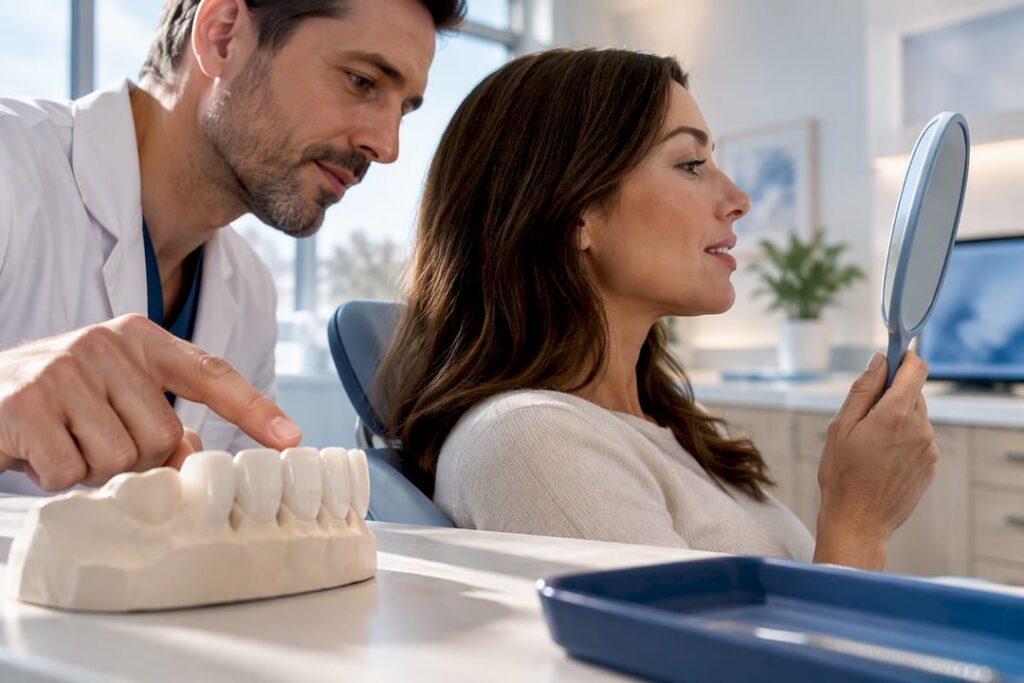
No prep veneers work well for adults with healthy enamel, minor gaps, mild wear, or light discoloration who want a straighter, brighter smile without drilling down healthy tooth structure. They are not a fix for significant crowding, protrusion, or deep intrinsic staining, and over-contouring is a real risk if a case is planned poorly. The one non-negotiable step before committing: a diagnostic mock-up and a full consult to confirm you’re actually a candidate.
TL;DR:
- No prep veneers are mainly suitable for mild cosmetic concerns like small gaps, minimal discoloration, or minor chips, and are ineffective for significant crowding or dark intrinsic stains.
- The success of no prep veneers heavily depends on careful case selection, including healthy enamel, good bite alignment, and proper mock-up planning.
- Long-term durability varies with material and maintenance, with recent studies showing favorable survival rates up to nine years, but with common risks such as chipping and debonding.
- Proper hygiene, avoiding hard foods, and wearing a night guard if needed are essential for maintaining veneer longevity and avoiding gum inflammation.
- A thorough consultation, including a mock-up and whole-mouth health assessment, is crucial before proceeding with no prep veneers to prevent costly failures.
Table of Contents
- What Are No Prep Veneers, and How Do They Differ From Traditional Veneers?
- Who Is a Good Candidate for No Prep Veneers?
- How Do No Prep Veneers Work, Step by Step?
- What Are the Real Benefits and Risks?
- How Long Do No Prep Veneers Actually Last?
- What Aftercare Do No Prep Veneers Need?
- What Do No Prep Veneers Cost, and What Drives the Price?
- What Should You Ask at Your Consultation?
- How Does a Minimally Invasive Practice Like Bay Area Dental, Airway & Sleep Approach No Prep Veneer Cases?
- What Are the Alternatives to No Prep Veneers?
- How Do No Prep and Traditional Veneers Compare on Looks and Function?
- Can No Prep Veneers Change Your Bite or Tooth Alignment?
- The Diagnostic Mock-Up Is Doing More Work Than Most Patients Realize
- Ready to See What a Personalized Smile Plan Looks Like?
- Sources
- FAQ
What Are No Prep Veneers, and How Do They Differ From Traditional Veneers?
No prep veneers are ultra thin ceramic shells bonded directly onto the front surface of a tooth with little or no enamel removed first. Traditional (prep) veneers require your dentist to grind down a layer of enamel to make room for a thicker restoration and to create a defined edge, called a finish line, where the veneer meets the natural tooth. No prep veneers skip that step almost entirely. They’re additive, meaning they build outward rather than replace what was ground away, which is why the JADA notes they can’t reliably narrow a crowded tooth or pull a protruding one back into line.
The materials matter more here than with prep veneers, because there’s no reduced tooth surface to help hide flaws underneath.
- Feldspathic porcelain: hand-layered by a ceramist, prized for the most lifelike translucency, but technique-sensitive to fabricate consistently.
- Lithium disilicate: stronger and more forgiving to work with, still translucent enough for a natural look in most cases.
- Ultrathin zirconia: the newest option, valued for strength at a very thin profile, though it handles light differently than porcelain.
These shells typically run about 0.2 to 0.5 millimeters thick, thinner than a credit card. That thinness is both the appeal and the limitation. It preserves your natural tooth, but it also means these veneers have less material to mask dark, tetracycline-stained, or heavily discolored teeth. And because there’s no defined finish line cut into the enamel, your dentist has to blend the veneer’s edge onto the existing tooth surface using contouring and polishing skill alone.
Who Is a Good Candidate for No Prep Veneers?
The best outcomes happen when the underlying tooth is already close to where you want to end up. According to a prospective case series on no-prep and partial veneers, the strongest candidates have healthy enamel and gums, reasonably good alignment, and cosmetic concerns limited to small chips, minor gaps, worn edges, or mild discoloration.
Good indications include:
- Small diastemas (gaps between front teeth) you’d like closed without orthodontics
- Minor chipping or unevenness along the biting edge
- Enamel that’s stained or dulled but not deeply discolored from the inside out
- Teeth that are slightly undersized relative to the rest of your smile
Contraindications are just as clear-cut:
- Deep intrinsic staining (tetracycline staining or severe fluorosis) that thin ceramic can’t mask
- Significant crowding, rotation, or protrusion, since no prep veneers can’t move teeth
- Active or untreated gum disease, which needs to be stabilized first
- Large existing fillings or root canal treated teeth with compromised structure
- Uncontrolled bruxism (teeth grinding) without a protective plan in place
If crowding or protrusion is the real issue, orthodontics needs to happen first or instead. If discoloration is mild and confined to the enamel surface, professional whitening or composite bonding might solve the problem for less money and zero commitment. A dentist confirming candidacy will check bite alignment, gum health, enamel thickness, and existing restorations before ever picking up a ceramic sample.
How Do No Prep Veneers Work, Step by Step?
The process runs on a fairly predictable track, though timing shifts depending on how many teeth are involved and how much revision the mock-up needs.
- Initial exam. Your dentist checks gum health, bite alignment, and enamel condition, and takes photos and X-rays as needed.
- Digital scan or impression. This captures the exact shape of your teeth for the lab.
- Diagnostic wax-up. A lab technician sculpts a preview of the proposed final shape, either digitally or by hand.
- Mock-up and try-in. A temporary version is placed in your mouth so you can see it, smile in it, and talk with it in place.
- Lab fabrication. Once the design is approved, the ceramist fabricates the final veneers, which usually takes one to two weeks depending on case complexity.
- Bonding appointment. The finished veneers are bonded permanently, with the dentist checking bite and margins before you leave.
The mock-up is the appointment that actually decides whether the final result works. It’s the one chance to catch a veneer design that looks too bulky, disrupts how your lips close, or changes your speech before it’s permanently bonded. Many practices structure treatment around two main visits, but complex cases with multiple revisions to the wax-up can add appointments.
Pro Tip: Ask to see the mock-up from the side, not just head-on in a mirror. Front-facing views hide over-contouring that becomes obvious in profile, and that’s the angle most patients regret not checking before bonding.
Reversibility is limited once bonding happens. Removing a no prep veneer means grinding it off, which can leave the underlying enamel roughened and sometimes vulnerable, so “reversible” really only applies before the final cementation step.
What Are the Real Benefits and Risks?
The upside is genuine when case selection is right. No prep veneers preserve tooth structure, often mean less or no anesthesia, tend to cause less post-treatment sensitivity than ground-down teeth, and typically involve a shorter chair-time preparation phase. Patient satisfaction runs high in published case series when the mock-up process is followed carefully.
The risks are just as real and mostly trace back to one issue: contour.
- Over-contouring is the most common complication. Bulky veneers trap plaque along the gumline and can trigger gum inflammation over time.
- No finish line means the margin where ceramic meets tooth has nowhere to hide, so any finishing flaw is visible and touchable with a tongue.
- Chipping or fracture can happen at the thin edges, especially on lower incisors under normal biting forces.
- Debonding is more likely if the enamel bonding surface wasn’t properly prepared or if moisture control during cementation was poor.
- Masking limits mean a genuinely dark tooth may still show through, however thin the shell.
A meta-analysis on periodontal outcomes and veneer margins found that margin finishing quality is one of the strongest predictors of whether gum tissue stays healthy around a veneer long term. Lab skill, meticulous cement cleanup at the margins, and your own daily hygiene around that edge all matter more with no prep veneers than with traditional ones, precisely because there’s no groove cut into the tooth to define where cleanup should stop.
How Long Do No Prep Veneers Actually Last?
A long-term comparative cohort found no-prep and minimally invasive veneers held up favorably against conventional veneers over a 9-year follow-up period. That’s a meaningfully long observation window for cosmetic dentistry, though the same research notes wide variation across studies in materials, technique, and how “success” was even defined.
Material-specific data is starting to fill in the picture. A 2025 retrospective series tracking ultrathin 5Y-TZP zirconia veneers reported 99.5% survival at 24 months, a strong short-term signal. The authors were explicit, though, that a two-year window on one material can’t be generalized to porcelain veneers, different labs, or longer timeframes.
Failure modes that show up repeatedly across the research:
- Chipping at thin margins under normal bite forces, debonding related to bonding-surface preparation or moisture control, and gum inflammation due to insufficiently finished margins have been noted as common failure modes.
The honest takeaway: expect variable longevity rather than a single guaranteed number. Case selection, material choice, and how well you maintain the margins do more to determine how long your veneers last than any average cited in a study abstract.
What Aftercare Do No Prep Veneers Need?
Maintenance is straightforward but not optional. According to guidance summarized by Healthline, patients should:
- Brush twice daily with fluoride toothpaste, paying particular attention to the gumline where the veneer margin sits.
- Clean between teeth daily, since plaque buildup at the margin is the leading driver of gum irritation around veneers.
- Keep up with regular professional cleanings, and ask specifically for a veneer margin check at each visit.
- Avoid biting into hard foods, ice, or objects like pen caps that put unnecessary stress on thin ceramic edges.
- Wear a night guard if you grind your teeth, since unprotected bruxism is one of the fastest ways to chip a no prep veneer.
Ask your dentist upfront what happens if a veneer chips or debonds. A single chipped veneer sometimes can be polished or bonded with composite; other times the whole shell needs replacement. Knowing the repair plan before you need it saves a stressful phone call later.
What Do No Prep Veneers Cost, and What Drives the Price?
Cost depends on several moving parts: the ceramic material chosen, the skill and reputation of the lab making the veneers, how many teeth are involved, case complexity, and regional differences in practice overhead. A single tooth in a straightforward case costs less than a full smile makeover spanning eight or ten visible teeth.
In the U.S. market, per-tooth pricing for no prep veneers commonly falls in a broad range, and any number quoted online should be treated as a rough estimate rather than a promise. Complex cases requiring multiple mock-up revisions or premium materials sit at the higher end.
- Dental insurance rarely covers cosmetic veneers, since they’re classified as elective.
- Some practices offer financing plans that spread payment over months.
- Always request a written estimate that separates the diagnostic mock-up, lab fees, and the bonding appointment.
- Ask specifically what a replacement veneer would cost years down the line, since that number is often left out of the initial quote.
Bay Area Dental, Airway & Sleep lists veneers and smile makeover services among its restorative and cosmetic offerings, with current pricing available directly through the practice.
What Should You Ask at Your Consultation?
A good consultation answers these questions before you ever agree to treatment. The American College of Prosthodontists frames informed consent for veneers around exactly this kind of disclosure: indications, risks, alternatives, and what happens later.
- Will any enamel be altered, and if so, where and how much?
- Can I see a physical mock-up or try-in before anything is finalized?
- What ceramic material and thickness are you planning to use, and why?
- How will you finish and manage the margins where the veneer meets my tooth?
- What’s the plan if a veneer chips, stains, or debonds down the road?
- What lifespan and maintenance schedule should I realistically expect?
Watch for red flags: a dentist who won’t provide a mock-up, gives vague answers about cost or maintenance, or pushes you to schedule treatment on the spot. Walk out with a written treatment plan, a written estimate, and a consent document that spells out risks and what replacement looks like. If any of those three things is missing, ask for it before you sign anything.
How Does a Minimally Invasive Practice Like Bay Area Dental, Airway & Sleep Approach No Prep Veneer Cases?
Some minimally invasive dental practices build no prep veneer planning around a holistic approach: treat the whole mouth, not just the cosmetic surface. Planning often includes more than tooth shape and color.
- 3D imaging to evaluate tooth structure, bone support, and existing restorations before any ceramic is designed.
- Occlusion and airway screening, since a bite or breathing issue left unaddressed can undermine even a well-made veneer over time.
- Mock-up and try-in review, giving patients a chance to approve contour and shape before lab fabrication locks it in.
- Accessible communication strategies, including tailored approaches to ensure treatment planning is genuinely understood.
When a case shows significant crowding, protrusion, or an untreated airway or bite issue, such practices may recommend orthodontics, whitening, or airway-focused therapy first, sometimes alongside or ahead of any cosmetic veneer work. That sequencing matters more than it sounds. A veneer bonded over an unresolved bite problem tends to fail faster and looks worse the moment the underlying issue resurfaces.
What Are the Alternatives to No Prep Veneers?
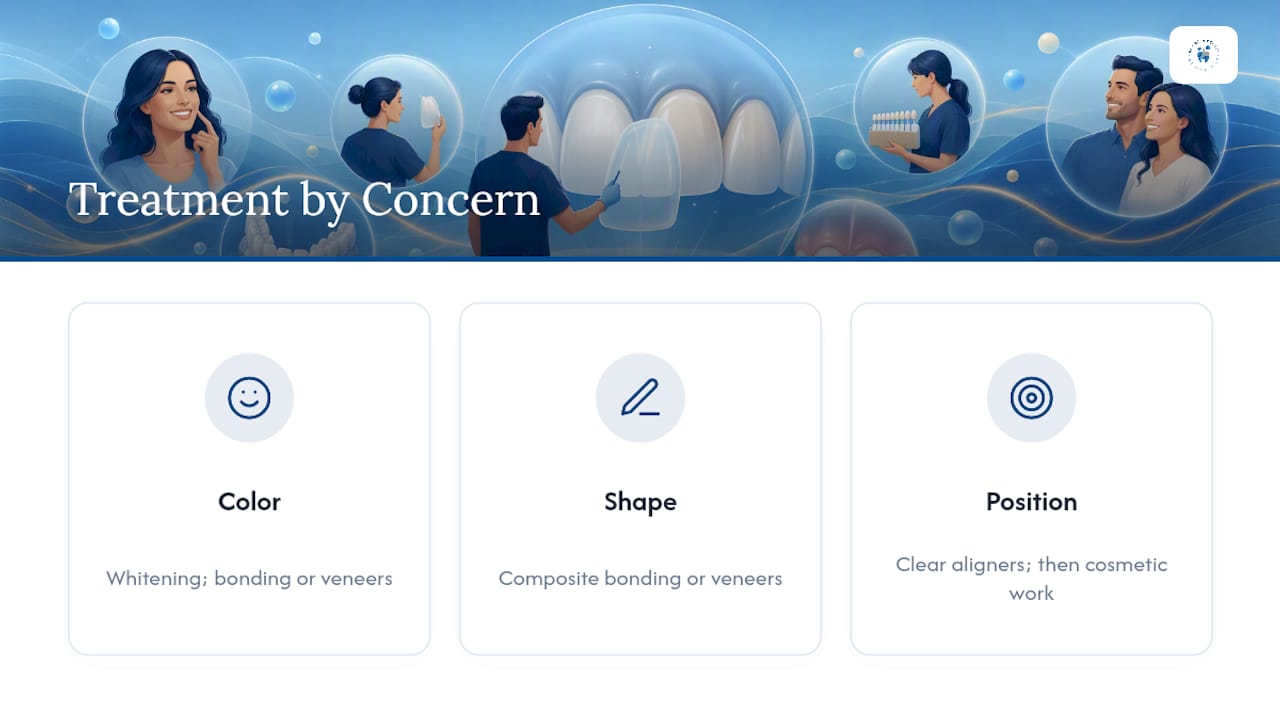
No prep veneers aren’t the only route to a straighter, brighter smile, and for some cases they’re not even the best one. A few common alternatives worth ruling in or out before committing:
Professional teeth whitening handles surface and mild internal discoloration without touching tooth structure at all. It’s reversible, inexpensive relative to veneers, and often enough on its own if color is your only concern.
Composite bonding uses tooth-colored resin sculpted directly onto the tooth, chairside, in a single visit. It costs less than ceramic veneers and can be repaired easily, though it doesn’t hold color or resist staining quite as well over years of coffee and red wine.
Traditional prep veneers remove a thin layer of enamel to create room for a thicker, more opaque restoration. They mask dark stains far better than no prep veneers can, and the defined finish line gives a lab more control over fit. The tradeoff is permanence: once enamel is removed, that tooth will need a veneer or crown indefinitely.
Clear aligner orthodontics solves crowding, rotation, and protrusion at the source by actually moving teeth, something no veneer can do. If misalignment is your main concern, aligners solve it permanently instead of disguising it under a ceramic shell.
Orthodontics combined with minor cosmetic work is often the right sequence for patients who have both alignment issues and cosmetic concerns. Straightening first, then adding conservative cosmetic touches afterward, usually produces a more stable, better-fitting result than veneers alone.
Which option makes sense depends entirely on what’s actually wrong with your smile: color, shape, position, or some mix of all three.
How Do No Prep and Traditional Veneers Compare on Looks and Function?
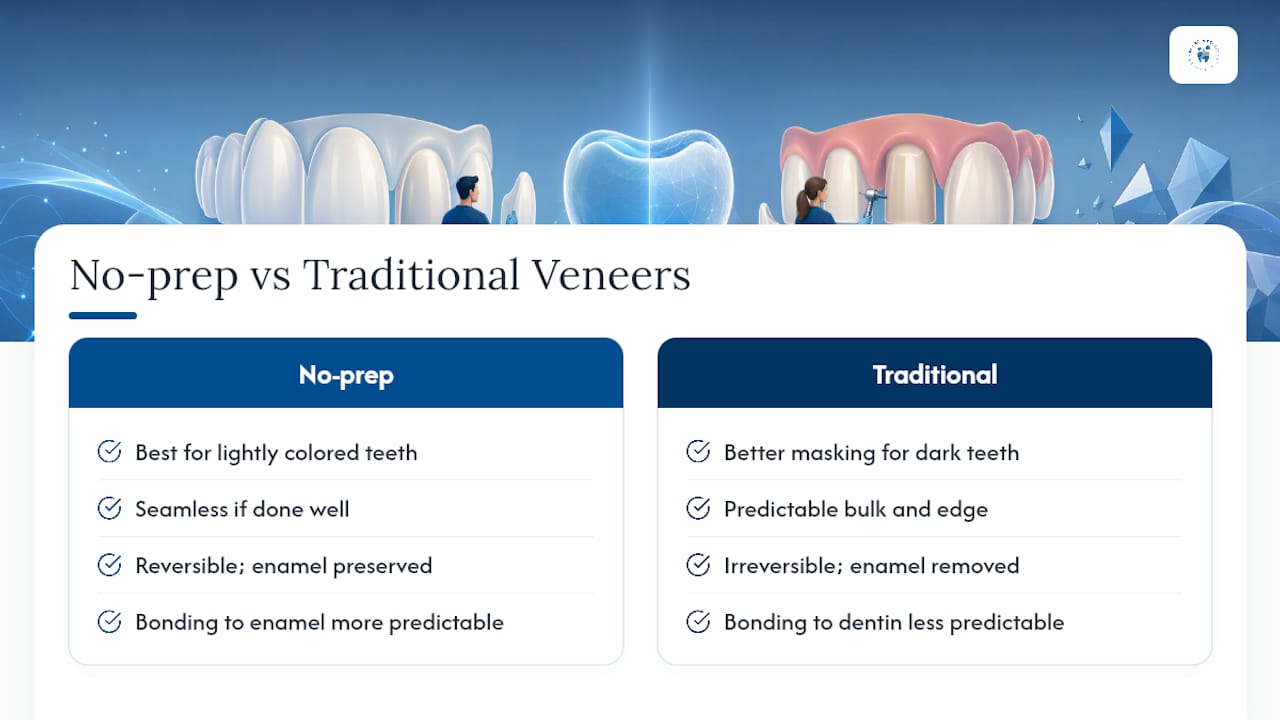
Aesthetically, traditional prep veneers generally win when a tooth is significantly discolored, because the thicker ceramic and prepared surface give the lab more material to work with for opacity and light control. No prep veneers, by contrast, tend to look most natural on teeth that were already reasonably light and well-shaped to begin with, since the thin ceramic layers over the existing tooth color rather than replacing it.
Functionally, the difference shows up mostly in bulk and bite feel. No prep veneers, done well, blend so seamlessly into the existing tooth contour that patients often don’t notice them with their tongue. Done poorly, they feel bulky at the gumline and can catch floss awkwardly. Traditional veneers, having replaced a layer of the tooth’s original surface, tend to have more predictable bulk and a cleanly defined edge, but that requires permanently removing healthy structure to achieve.
Where no prep veneers clearly win is reversibility and biological cost. Enamel that’s never removed is enamel you keep, and bonding to enamel is inherently more predictable than bonding to dentin, which is exposed once enamel is ground away for a prep veneer. Where traditional veneers clearly win is masking power and edge control, particularly on teeth with real discoloration or structural irregularity.
Neither option is universally better. The right choice depends on how much your natural tooth already resembles the smile you want, and how much correction versus preservation matters to you personally.
Can No Prep Veneers Change Your Bite or Tooth Alignment?
No prep veneers don’t move teeth, and they were never designed to. Because they’re purely additive, ceramic layered onto an existing tooth surface, they can’t narrow a crowded tooth, pull a protruding tooth backward, or correct a rotation. Treating alignment problems with veneers alone is sometimes marketed as a fast alternative to braces, but the Journal of the American Dental Association is direct about the limits: veneers can visually improve the appearance of minor irregularities, but they cannot substitute for actual tooth movement when the underlying problem is structural.
What no prep veneers can do is subtly change how your bite feels, especially if the added thickness at the front alters where your upper and lower teeth first make contact. A well-planned case accounts for this during the mock-up phase, checking that the new contours don’t create a premature contact point or throw off how your jaw closes. A poorly planned case can leave a patient with a veneer that feels “high,” causes discomfort when biting down, or accelerates wear on opposing teeth.
This is exactly why occlusion gets checked before veneers are ever designed, not after. If your bite already has issues, whether from crowding, an open bite, or airway-related jaw positioning, addressing that first (often through orthodontics or a coordinated airway evaluation) tends to produce a more stable, comfortable result than layering veneers over an unresolved bite problem and hoping it settles.
The Diagnostic Mock-Up Is Doing More Work Than Most Patients Realize
Most of what gets written about no prep veneers treats the mock-up as a nice-to-have, a chance to preview your smile before committing. That framing undersells it. The mock-up is the single point in the entire process where a poorly conceived case gets caught before it becomes a permanent problem, and skipping it, or rushing through it, is where most of the disappointing outcomes in this category actually originate.
The conventional advice tells patients to focus on material choice: porcelain versus zirconia, feldspathic versus lithium disilicate. That’s a real consideration, but it’s downstream of a bigger question few patients think to ask, which is whether their bite, gum health, and jaw function were evaluated before anyone talked about ceramic at all. A beautifully fabricated veneer bonded onto an unaddressed bite problem is still a failure waiting to happen, just a more expensive one.
If you’re weighing no prep veneers, prioritize the practice that treats the mock-up and the whole-mouth exam as the real decision point, not the ceramic catalog. The material matters less than whether anyone checked what your mouth was doing before deciding to change how it looks.
— Admin
Ready to See What a Personalized Smile Plan Looks Like?
Reading about no prep veneers only gets you so far. What actually tells you whether they’re right for your teeth is a hands-on exam paired with a diagnostic mock-up, the same process outlined throughout this guide. Bay Area Dental, Airway & Sleep builds that evaluation around whole-mouth health, checking bite and airway function alongside cosmetic goals, rather than jumping straight to a ceramic sample book.
A consult starts with an exam, a conversation about what you want your smile to look like, and, if you’re a reasonable candidate, a mock-up try-in so you can see the proposed change before committing to anything. Bring a list of what bothers you about your current smile and any photos of smiles you like. If crowding, bite issues, or airway concerns show up during the exam, you’ll hear about it honestly, along with what sequencing (orthodontics first, whitening first, or straight to veneers) actually makes sense for your case. Explore veneers and smile makeover options or visit the practice homepage to book your exam and see a personalized plan take shape.
This article is general information, not a substitute for advice from a qualified doctor. Consult a qualified healthcare professional about your own circumstances before acting on anything here.
Sources
- The Journal of the American Dental Association (JADA) — The Myth of Instant Orthodontics
- Esthetic Rehabilitation of the Smile with No-Prep Porcelain Laminates and Partial Veneers (PMC)
- American College of Prosthodontists — Parameters of Care (informed consent guidance)
FAQ
Are No Prep Veneers Any Good?
They’re a strong option for patients with healthy enamel, minor gaps, or mild discoloration who want to avoid grinding down tooth structure. A long-term cohort study found favorable survival compared to traditional veneers, though outcomes depend heavily on case selection and how carefully the mock-up phase was handled.
How Much Does a No Prep Veneer Cost?
Pricing varies by material, lab quality, and how many teeth you’re treating, so there’s no single national figure to quote reliably. Bay Area Dental, Airway & Sleep lists current veneer and smile makeover pricing directly through the practice, and any consult should end with a written estimate before treatment begins.
Do Teeth Rot Under No Prep Veneers?
Teeth don’t decay from the veneer itself, but poor margin finishing or inconsistent hygiene around the edge can trap plaque and lead to gum problems and, eventually, decay at the margin. A meta-analysis on veneer margins found that finishing quality and daily hygiene at the gumline are the strongest predictors of healthy long-term outcomes.
How Long Do No Prep Veneers Last?
Longevity varies by material and case, but a 9-year comparative study showed favorable survival for no prep and minimally invasive veneers against conventional veneers. Newer material-specific research on ultrathin zirconia reported 99.5% survival at 24 months, though that short-term figure shouldn’t be assumed to apply across all materials or techniques.