

Porcelain veneers generally last around a decade to a decade and a half, and many patients enjoy longer lifespans when the veneers are bonded to healthy enamel and cared for properly. Key factors include the porcelain type used, the amount of natural enamel remaining under the restoration, and the presence of teeth grinding. Wearing a night guard, maintaining regular checkups, and avoiding harmful habits can improve longevity. Skip those steps, and you’re gambling with a restoration that isn’t cheap to redo.
TL;DR:
- Bonding veneers to healthy enamel significantly improves their survival rate, with up to 96% lasting over 10 years according to clinical data.
- Lithium disilicate is generally the preferred porcelain for durability on front teeth, while zirconia is reserved for heavy bite forces on molars.
- Bruxism is the biggest risk factor for early veneer failure, making a custom night guard essential for many patients.
- Proper preparation, bond protocol, and occlusion management before cementation are crucial steps that affect long-term success.
- Routine habits like gentle flossing, avoiding hard objects, and regular checkups can extend veneer lifespan and prevent costly repairs.
Table of Contents
- What the Research Says About Porcelain Veneers Lifespan
- Does the Type of Porcelain Change How Long Veneers Last?
- What Actually Shortens or Extends Veneer Life?
- Your Checklist for Making Veneers Last Longer
- Signs Your Veneer Needs Attention
- What We Prioritize When Planning for Long-Lasting Veneers
- Ready for Veneers Built to Last? Here’s Your Next Step
- Sources
- FAQ
What the Research Says About Porcelain Veneers Lifespan
Clinical data backs up the 10 to 15 year figure, and some studies push well past it. A comprehensive narrative review found survival rates above 90% beyond the 10-year mark when veneers were bonded to healthy enamel rather than exposed dentin. A separate 21-year clinical follow-up study recorded a high survival rate at the 10-year checkpoint under similar bonding conditions, and a meaningful share of those veneers were still functioning well past two decades.
Statistic Callout: Veneers bonded to enamel showed close to 96% survival at 10 years in long-term clinical tracking, versus notably lower survival when bonding occurred on exposed dentin.
Why the range in numbers between studies? A few reasons:
- Follow-up length varies widely, so a five-year study can’t tell you what happens at year 15.
- Some studies track minimal-prep or no-prep veneers, which tend to survive longer than heavily prepared ones.
- Patient populations differ; a study group with more bruxers will show worse outcomes than one without.
Fracture and debonding remain the two failure modes that show up again and again across the literature, which is exactly why the sections below focus on preventing both.
Does the Type of Porcelain Change How Long Veneers Last?
Not all ceramic is built the same, and the material your dentist chooses affects both how your smile looks and how long it holds up.
- **Feldspathic porcelain produces the most lifelike, translucent result and remains a favorite for very thin, minimal-prep veneers. It’s also the most brittle of the common options, with lower fracture resistance than newer materials.
- Leucite-reinforced ceramic (often marketed under names like Empress) splits the difference, offering good esthetics with a modest strength boost over straight feldspathic porcelain.
- Lithium disilicate (e.max) has become the default choice for many cosmetic cases because it holds up better under everyday biting forces while still looking natural. Long-term clinical data tends to favor lithium disilicate over feldspathic porcelain for real-world fracture resistance.
- Zirconia is the strongest of the group and shows up mainly on molars or in patients with heavy bite forces, since its added opacity can make it look less natural on front teeth.
A dentist weighing durability against appearance will often lean toward lithium disilicate for front teeth that need to survive daily wear, and reserve zirconia for cases where strength has to win over translucency.
What Actually Shortens or Extends Veneer Life?
Two sets of factors decide how your veneers age: what you do, and what your dentist does before the veneer ever gets cemented.
On the patient side, bruxism is the single biggest wildcard. Grinding puts repeated, concentrated force on the thinnest part of the restoration, and clinicians consistently report far higher fracture and debonding rates in untreated grinders. Add in poor hygiene around the margins, a diet heavy in acidic drinks or hard, crunchy foods, smoking, and habits like nail-biting or chewing pen caps, and you’re stacking risk on top of risk.
On the clinical side:
- Enamel preservation matters more than almost anything else. Veneers bonded to enamel bond far more reliably than those bonded to exposed dentin.
- Preparation technique affects how evenly the veneer seats and how much surface area is available for a strong bond.
- Bonding protocol, including etching, silane application, and avoiding contamination during cementation, directly affects debonding rates.
- Occlusion management, meaning your dentist checks your bite in every direction before finalizing the veneer, catches high spots that would otherwise crack porcelain within months.
Pro Tip: If you know you grind your teeth, ask about a custom night guard before your veneers are even placed. Treating bruxism at the planning stage is far cheaper than replacing a fractured veneer later.
Your Checklist for Making Veneers Last Longer
Longevity comes down to a short list of habits, done consistently.
- Brush at the gumline, not just the tooth surface. Veneer margins are where decay and staining start, so angle your brush there twice a day.
- Floss gently but daily. Snapping floss down onto a veneer margin can chip the edge; slide it in and out slowly instead.
- Skip abrasive whitening toothpaste. Some whitening formulas contain grit that wears down the polish on porcelain over time. Ask your dentist which brands are veneer-safe.
- Wear a night guard if you grind. This single habit does more for long-term veneer survival than almost anything else on this list.
- Avoid biting hard objects. Ice, fingernails, pen caps, and popcorn kernels are common culprits behind chipped veneers.
- Limit staining and acidic beverages. Coffee, red wine, and soda won’t destroy porcelain, but they can stain the cement line and bonding margins over time.
- Keep up with routine exams and cleanings. The American Dental Association recommends checkups on a regular schedule, and your dentist should inspect veneer margins at every visit.
- Get an annual veneer-specific check. A quick look at margins, bite contact, and surface wear catches small problems before they become expensive ones.
Signs Your Veneer Needs Attention
A few warning signs mean it’s time to call your dentist rather than wait for the next scheduled cleaning:
- A visible chip or rough edge you can feel with your tongue
- A veneer that feels loose or shifts slightly under pressure
- Darkening or a gray line at the gumline margin
- New sensitivity to hot, cold, or sweet foods
- Recurring decay at the edge of the restoration
Small chips and a veneer that has come loose but is otherwise intact can often be treated with rebonding or a composite repair rather than a full remake. Larger fractures, decay underneath the restoration, or a veneer that’s cracked through usually mean it’s time to replace it. Your dentist will check the bite, the margin seal, and the health of the tooth underneath before deciding which route makes sense.
What We Prioritize When Planning for Long-Lasting Veneers
Most conversations about veneer lifespan focus entirely on the porcelain. That’s backwards. The material matters, but the planning that happens before cementation determines whether that material ever gets the chance to last 15 years or fails in year three.
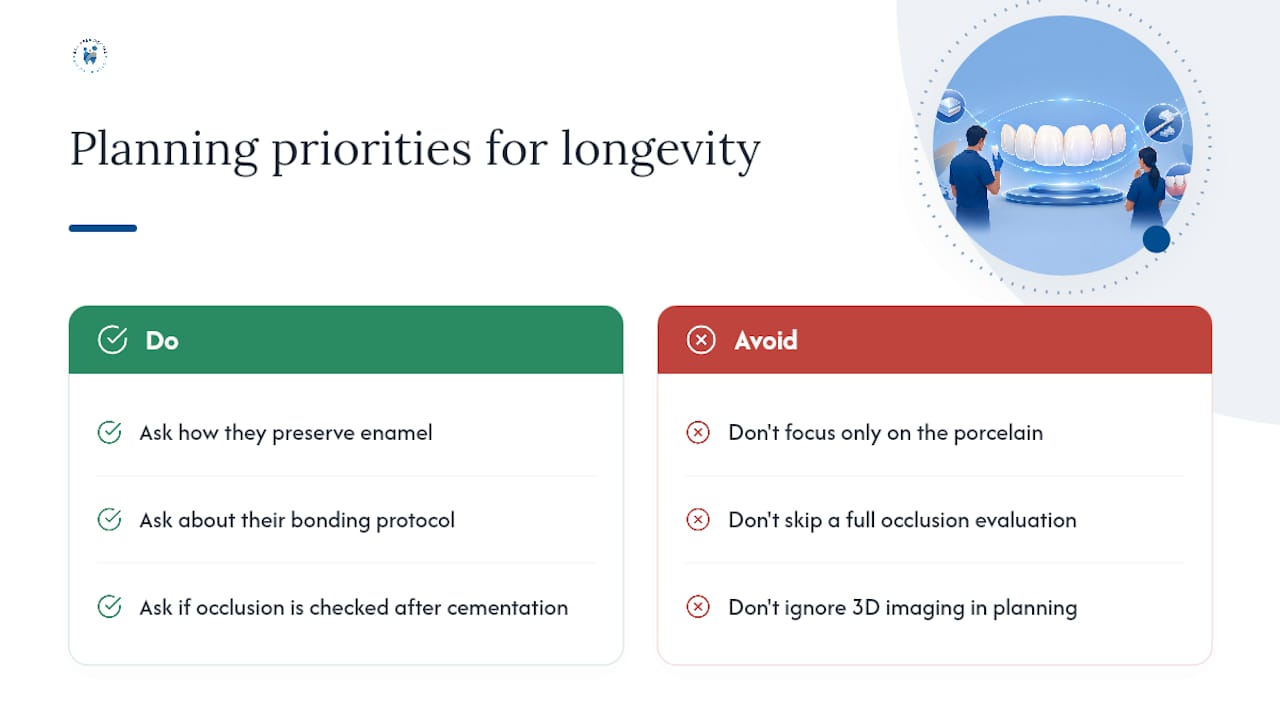
That planning starts with protecting enamel wherever possible, since bonding to healthy enamel is consistently tied to better long-term survival in the clinical literature. It continues with a full occlusion evaluation, checking how your bite moves in every direction, not just straight up and down, because a high spot missed during placement is often what causes a fracture months later. Utilizing 3D imaging in the planning process can allow a dentist to see the tooth structure and bite relationships in more detail before a single millimeter of porcelain gets prepared.
If you’re evaluating a dentist for veneers, ask directly how they handle enamel preservation, what their bonding protocol looks like, and whether occlusion gets checked immediately after cementation. Those three questions tell you more about your veneers’ odds of lasting than any brochure will.
— Admin
Ready for Veneers Built to Last? Here’s Your Next Step
Getting 15 to 20 years out of a veneer isn’t luck. It comes down to enamel preservation, a careful bonding protocol, and a bite check that catches problems before they become fractures, exactly the planning approach behind Dental Veneers and Smile Makeovers at Bay Area Dental, Airway & Sleep.

If grinding is part of your picture, a custom night guard planned alongside your veneers protects your investment from day one rather than after the first crack shows up. And because veneer longevity depends just as much on routine upkeep as on the initial work, staying current with preventative exams and cleanings matters as much as the placement itself. If you’re weighing veneers and want a plan built around durability, not just appearance, book a consultation with Bay Area Dental, Airway & Sleep and ask specifically about a veneer longevity assessment.
This article is general information, not a substitute for advice from a qualified doctor. Consult a qualified healthcare professional about your own circumstances before acting on anything here.
Sources
- Longevity of Porcelain Veneers: A Comprehensive Review
- Long-term clinical outcomes of porcelain veneers (21-year study)
- American Dental Association patient resources on veneers
FAQ
What happens after 20 years of veneers?
Many veneers bonded to healthy enamel are still functioning well past 20 years, though the porcelain typically shows some surface wear and the cement line may need attention. A 21-year clinical study found strong survival rates well beyond the 10-year mark under good bonding conditions. Eventually, most veneers that age out this well need replacement due to cosmetic changes rather than structural failure.
What is the downside of porcelain veneers?
The main downsides are that the procedure often requires removing a thin layer of enamel, which is irreversible, and that veneers can chip or debond under heavy bite force or grinding. The American Dental Association also notes that veneers aren’t permanent and eventually need replacement regardless of how well they’re cared for.
What do veneers look like after 10 years?
Well-maintained veneers usually still look natural after 10 years, with minor surface wear and possibly some margin discoloration at the gumline. A narrative review found survival rates above 90% at this stage when veneers were bonded to enamel, meaning most patients aren’t dealing with major problems by year 10.
What is the 4-8-10 rule for veneers?
There’s no established clinical framework by this name in dental literature or ADA guidance. If you’ve seen it referenced online, treat it as informal shorthand rather than a recognized standard, and ask your dentist directly about realistic timelines for repair, touch-up, and replacement based on your specific veneers.
How often should veneers be checked by a dentist?
Veneers should be evaluated at every routine dental visit, which most dentists and the American Dental Association recommend scheduling regularly for cleanings and exams. An annual veneer-specific check of margins, bite contact, and surface wear catches small issues before they turn into fractures or decay.