
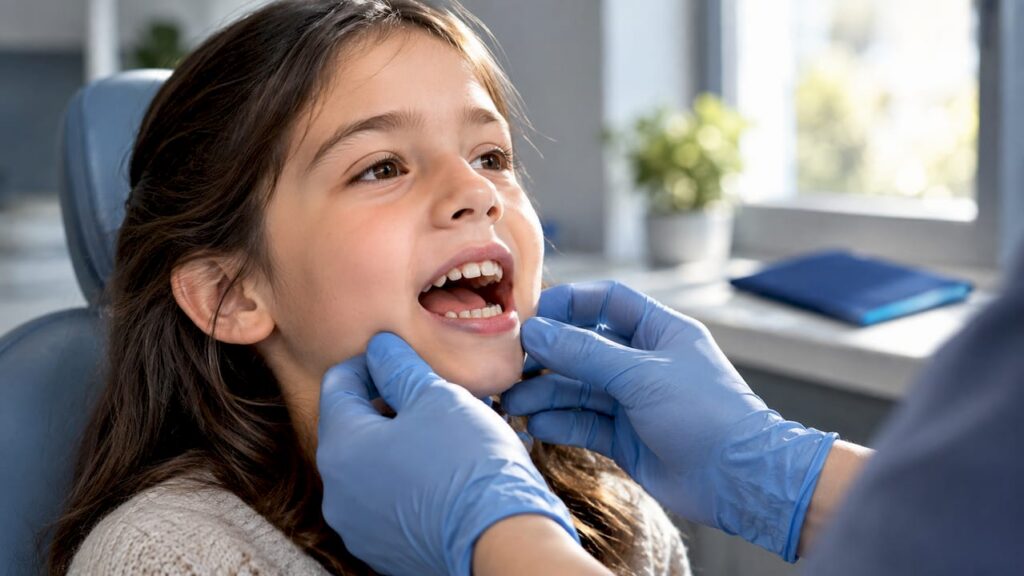
Interceptive orthodontics is early treatment, usually started between ages 6 and 11, that guides jaw growth, creates space for permanent teeth, or corrects a developing crossbite before it becomes a bigger problem. Not every child needs it. The American Association of Orthodontists recommends a first evaluation by age 7, but research shows the strongest results come from treating specific, clearly diagnosed issues rather than starting early treatment for everyone.
TL;DR:
- Early orthodontic treatment is most effective when targeting specific functional issues, such as crossbites or habits, rather than applying it universally to all children.
- Most interventions last 9 to 15 months, followed by monitoring, with the goal of reducing the complexity or duration of subsequent Phase 2 treatment.
- Proper appliance use and parental compliance are crucial to prevent relapse and ensure treatment progress, especially with removable devices.
- Interceptive orthodontics is supported by research for correcting or improving about 15% of malocclusions, but long-term skeletal benefits are inconsistent beyond specific conditions.
- Treatment costs vary, insurance coverage is inconsistent, and early intervention should be carefully planned based on clear indications rather than routine early treatment.
Table of Contents
- What Is Interceptive Orthodontics and How Does It Differ From Phase 2?
- What Signs Mean My Child Should See an Orthodontist?
- What Appliances Are Used in Interceptive Orthodontics?
- How Long Does Interceptive Treatment Typically Take?
- Does the Research Actually Support Early Treatment?
- Why Do Some Kids Relapse and How Can Parents Help?
- How Bay Area Dental, Airway & Sleep Approaches Early Treatment
- What Risks Come With Early Orthodontic Appliances?
- What Does Interceptive Orthodontics Cost, and Will Insurance Help?
- How Does Interceptive Orthodontics Compare to Other Early Interventions?
- Can Early Treatment Help a Child’s Confidence?
- What Happens After Interceptive Treatment Ends?
- The Honest Take on Early Orthodontic Treatment
- Ready to Get Your Child’s Bite Evaluated?
- Sources
- FAQ
What Is Interceptive Orthodontics and How Does It Differ From Phase 2?
Interceptive orthodontics, often called Phase 1 treatment, targets a developing problem while a child’s jaw is still growing and baby teeth are mixed in with permanent ones. The goals are specific: guide jaw growth into a better relationship, hold or create space for teeth that haven’t erupted yet, correct a crossbite, or stop a harmful habit like prolonged thumb sucking before it reshapes the palate, as detailed in Parte II: Collaboratori e Prestazioni.
Phase 2 is different. It’s the comprehensive treatment, usually full braces or clear aligners, that happens once most or all permanent teeth have come in, typically in the early teen years. Think of Phase 1 as setting up the foundation and Phase 2 as finishing the structure. A child with a narrow upper jaw might get a palatal expander at age 8 (Phase 1), then braces at age 13 to align the teeth themselves (Phase 2).
General dentists often spot early warning signs during routine checkups and refer families to an orthodontist for a full evaluation. Not every referral leads to treatment. Sometimes the recommendation is simply to monitor growth every six to twelve months.
What Signs Mean My Child Should See an Orthodontist?
The American Association of Orthodontists recommends an evaluation by age 7, because that’s when the first permanent molars and incisors typically emerge, giving an orthodontist enough information to spot developing bite problems while there’s still room to intervene.
Watch for these signs at home:
- A crossbite, where upper teeth sit inside the lower teeth when your child bites down
- A jaw that shifts or clicks when opening and closing
- Noticeably protruding front teeth (increased overjet)
- Baby teeth lost much earlier or later than siblings or peers
- Mouth breathing, snoring, or difficulty chewing certain foods
- Speech sounds that seem affected by tooth position
Some situations call for a faster referral than “wait for the next checkup.” A functional crossbite that forces the jaw to shift sideways, a clear facial asymmetry, or front teeth so protruded they’re at real risk during sports or play all warrant a sooner look.
What Appliances Are Used in Interceptive Orthodontics?
Different problems call for different tools, and the appliance your orthodontist recommends says a lot about what’s actually being treated.
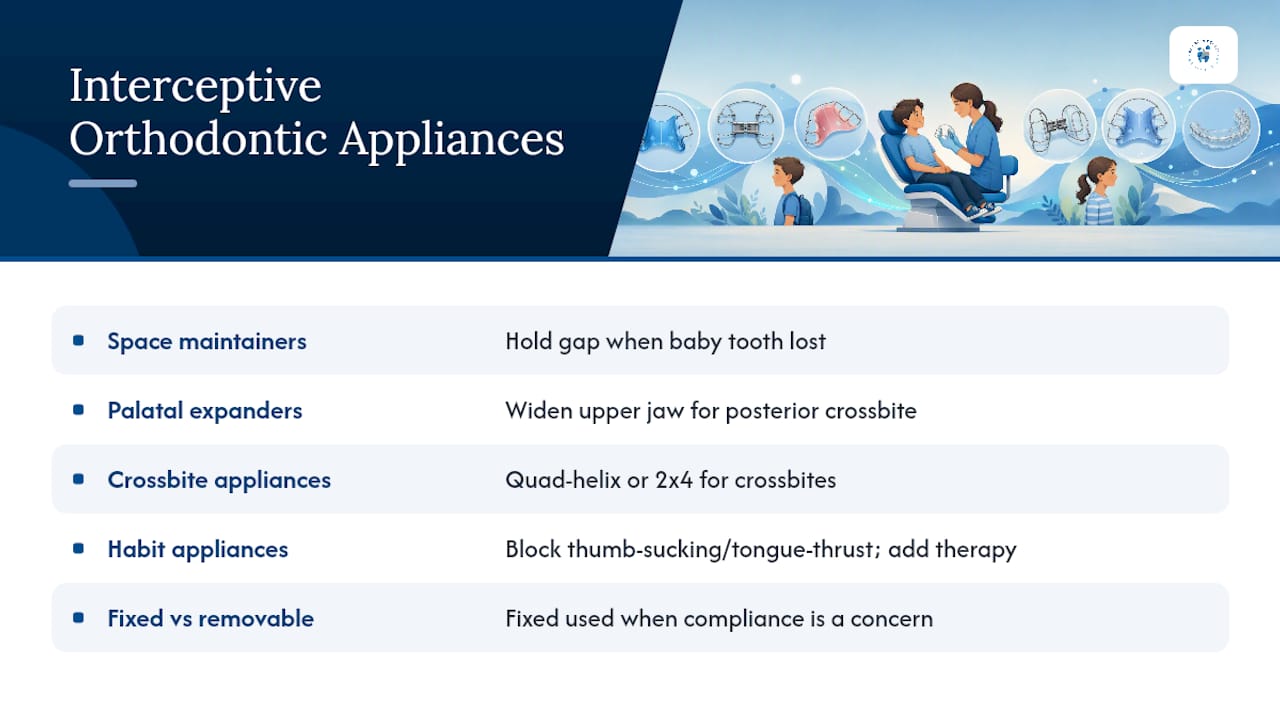
Space maintainers step in after a baby tooth is lost too early, often from decay or trauma. They hold the gap open so neighboring teeth don’t drift into it before the permanent tooth is ready to erupt. Some are fixed to a nearby tooth; others are removable, though removable versions require a child who won’t lose or skip wearing them.
Palatal expanders (rapid palatal expansion, or RPE) widen a narrow upper jaw, usually to fix a posterior crossbite. A parent turns a small key to activate the screw, typically once a day for several weeks, before the appliance stays in place for another 9 to 12 months to let the new bone stabilize.
Crossbite correction varies by location. A quad-helix or removable expansion plate handles a posterior (back tooth) crossbite, while a 2×4 fixed appliance, so named for its two molar bands and four front brackets, corrects an anterior crossbite, often faster than removable options because there’s no compliance question.
Habit appliances, like a tongue crib, physically block a thumb-sucking or tongue-thrusting habit that’s pushing teeth out of alignment. Myofunctional therapy exercises often run alongside these appliances, retraining tongue posture and swallowing patterns so the habit doesn’t simply resume once the appliance comes out.
Fixed appliances tend to get chosen over removable ones specifically when a family is worried about a child forgetting or refusing to wear something removable.
Pro Tip: Ask your orthodontist which appliance category you’re dealing with, space, crossbite, or habit, before you get into brand names. Understanding the category makes every follow-up conversation easier.
How Long Does Interceptive Treatment Typically Take?
Most interceptive treatment happens in that 6 to 11 age window because it lines up with a mix of primary and permanent teeth, and because jaw growth is still active enough to guide.
- Active treatment with an appliance like an RPE or quad-helix usually runs about 9 to 15 months, depending on the appliance and how much correction is needed.
- Retention and monitoring follow, often another several months to a year, to let bone and tissue stabilize around the new position.
- A rest period sometimes comes next, where the orthodontist simply watches growth and eruption patterns without active treatment.
- Phase 2 evaluation happens once most permanent teeth are in, usually in the early teens, to decide whether comprehensive braces or aligners are still needed.
Appointments during Phase 1 are usually short: a fitting visit, then periodic activation or monitoring checks every 4 to 8 weeks. Interceptive treatment doesn’t always eliminate the need for Phase 2, but it can shorten it or make it more straightforward by resolving the underlying skeletal or spacing issue early.
Does the Research Actually Support Early Treatment?
The evidence is genuinely mixed, and that nuance matters more than any single statistic. Research on targeted interceptive measures estimates that about 15% of malocclusions can be completely corrected and nearly 50% significantly improved with early treatment. That’s a meaningful number, but it’s not the whole story.
Systematic reviews consistently find that early treatment produces real short-term improvements, but the long-term skeletal advantages compared with delayed treatment are inconsistent once children reach adolescence.
The evidence splits by condition. Posterior crossbites, some Class III presentations, and habit-related problems tend to respond well and hold up over time, particularly with simple appliances like RPE. Routine early correction of Class II problems purely for skeletal change is far more debated. Some studies show it helps; others find the same result could have been achieved just as well by waiting for Phase 2.
The practical takeaway: early, selective intervention makes sense when there’s a clear functional indication, a crossbite causing a jaw shift, a habit reshaping the palate, or trauma risk from protruding teeth. Absent that, watchful monitoring is often the more defensible path.
Why Do Some Kids Relapse and How Can Parents Help?
Compliance drives outcomes more than most parents expect, especially with removable appliances. A crib or expander that sits in a drawer instead of a mouth does nothing. Parents play a direct role here: turning the expansion key on schedule, checking that a removable retainer or habit appliance is actually being worn, and flagging soreness or looseness early rather than waiting for the next visit.
Relapse after expansion happens when the new bone position isn’t held long enough, which is exactly why retention periods exist. Daily care is straightforward: brush around brackets and wires carefully, expect a few days of soreness after each activation, and always use a properly fitted mouthguard during contact sports rather than skipping it because of the appliance. If a habit or airway issue seems to be driving the problem, that’s the moment to ask about myofunctional therapy or a broader airway evaluation rather than just replacing the appliance.
How Bay Area Dental, Airway & Sleep Approaches Early Treatment
Bay Area Dental, Airway & Sleep treats interceptive care as part of a whole-body picture rather than an isolated bite fix. That means pairing a traditional orthodontic exam with airway assessment, 3D imaging, and myofunctional therapy evaluation, since mouth breathing or tongue posture can quietly undermine an otherwise well-planned appliance. A typical visit includes a coordinated evaluation, an appliance recommendation built around your child’s specific findings, and communication support for families who need it, including accommodations for Deaf patients. The goal is a plan that treats the cause, not just the symptom sitting in front of you.
What Risks Come With Early Orthodontic Appliances?
Interceptive appliances are generally safe when properly fitted and monitored, but they aren’t risk-free, and parents deserve a clear picture before agreeing to treatment.
Soreness and irritation are the most common complaints, especially in the first few days after fitting or activation. Speech can be temporarily affected by an appliance sitting against the palate, particularly with expanders, though most children adjust within a week or two. Fixed appliances create more places for food to get trapped, which raises the stakes on daily brushing and can contribute to decalcification or cavities if hygiene slips for months at a time.
Relapse is the risk that worries clinicians most. If retention isn’t followed properly after expansion, teeth and bone can drift back toward their original position, which means the time and effort invested in Phase 1 partially unwind. There’s also a case-selection risk: treating a condition that would have resolved on its own, or that responds just as well to Phase 2 later, exposes a child to appliance wear time without a proportional benefit. This is exactly why AAO guidance frames early evaluation as a chance to identify which children actually benefit from early intervention, rather than a blanket recommendation to treat everyone early.
Rare but real risks include allergic reactions to appliance materials and root resorption with certain fixed appliances used over extended periods. None of these should scare a family away from treatment that’s clearly indicated, but they’re reasons to ask specific questions about the appliance type, expected duration, and monitoring schedule before starting.
What Does Interceptive Orthodontics Cost, and Will Insurance Help?
Cost varies significantly based on the appliance, the length of treatment, and your location, so it’s worth asking your orthodontist for a written estimate specific to your child’s case rather than relying on a general figure.
Insurance coverage for interceptive treatment is inconsistent across plans. Some dental insurance policies cover a portion of Phase 1 treatment under orthodontic benefits, particularly when there’s a clear functional diagnosis like a crossbite or space loss. Others treat Phase 1 and Phase 2 as a single lifetime orthodontic benefit, meaning money spent early reduces what’s available later. A few plans exclude interceptive treatment entirely, categorizing it as elective unless medical necessity is documented.
A few practical questions are worth asking your insurer directly: does the plan have a lifetime orthodontic maximum, and does Phase 1 count against it? Is there an age restriction on orthodontic benefits? Does coverage depend on a specific diagnosis code, such as a documented crossbite versus a cosmetic concern? Payment plans are common at orthodontic practices specifically because Phase 1 and Phase 2 costs, taken together, add up over several years.
The financial calculation isn’t purely about the sticker price of Phase 1. If early intervention genuinely shortens or simplifies Phase 2, treatment for a real functional problem, not just early alignment for its own sake, that comprehensive-care efficiency is part of the cost conversation, not just the invoice sitting in front of you today.
How Does Interceptive Orthodontics Compare to Other Early Interventions?
Interceptive orthodontics isn’t the only early dental intervention on the table, and it’s worth knowing where it fits relative to the alternatives.
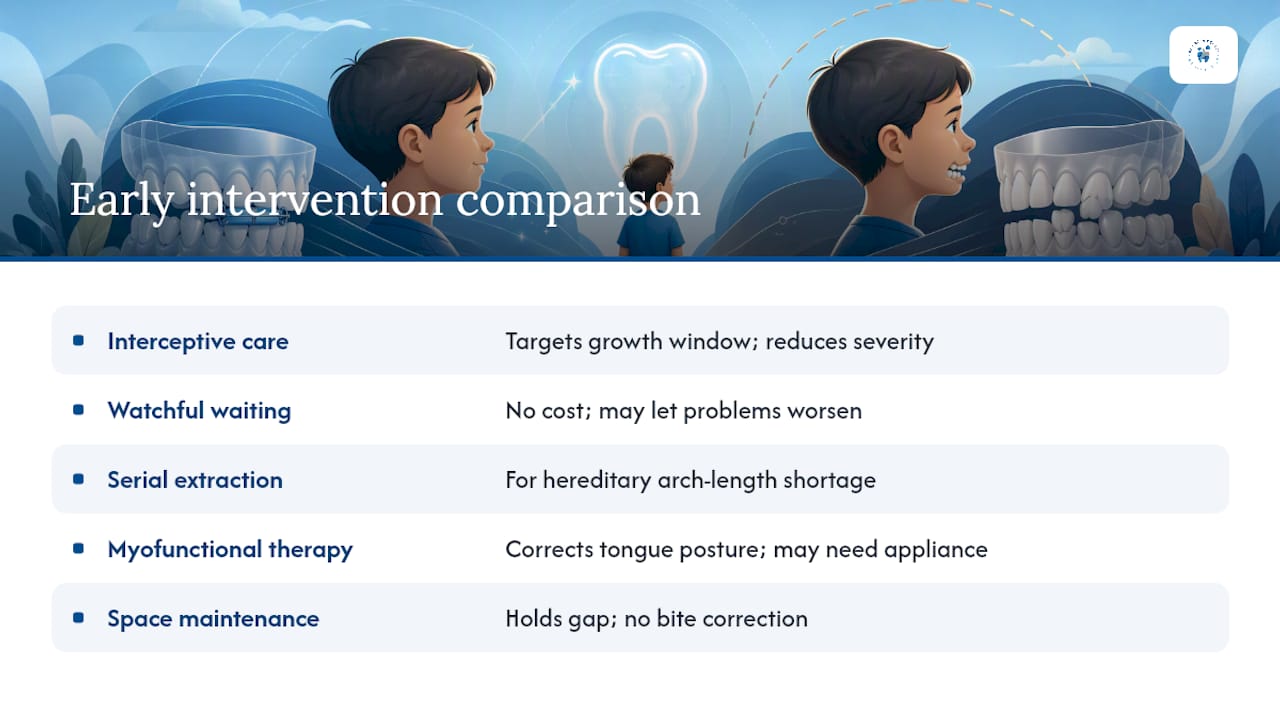
Watchful waiting costs nothing and carries no appliance risk, but it means accepting that a developing problem, if there is one, will progress until Phase 2. For conditions with strong evidence behind early treatment, like a functional posterior crossbite, waiting can mean a harder, longer fix later.
Serial extraction, removing specific baby teeth in a planned sequence to guide permanent tooth eruption, works for genuine hereditary arch-length shortages but is far less commonly indicated than parents sometimes assume. It’s a narrower tool than general interceptive appliance therapy.
Myofunctional therapy alone, without an appliance, can address tongue posture and swallowing patterns that contribute to open bites or narrow arches. It’s a reasonable first step for habit-driven problems, though it’s often paired with, not substituted for, an appliance when the skeletal issue has already progressed.
Space maintenance without full interceptive treatment is the narrowest intervention: it holds a gap open after early tooth loss without attempting to correct a bite or jaw relationship at all.
The comparison that matters most for research comparing interceptive to comprehensive treatment in public-health settings: interceptive care reduced malocclusion severity and improved access to treatment, but comprehensive Phase 2 treatment still produced the larger overall correction. Interceptive orthodontics is a targeted, growth-window tool, not a replacement for comprehensive care when comprehensive care is what’s actually needed.
Can Early Treatment Help a Child’s Confidence?
The psychological upside of interceptive orthodontics doesn’t show up in a clinical scan, but it’s real for a lot of families. Correcting a visible crossbite, closing a gap from an early lost tooth, or reducing protruding front teeth before middle school can spare a child year of self-consciousness during exactly the age range when peer comparison starts to sting.
There’s a practical safety angle tied to this too. Reducing significant overjet lowers the risk of dental trauma to protruding front teeth during sports or normal childhood roughhousing, which means fewer emergency visits and less risk of a chipped or knocked-out tooth becoming its own long-term cosmetic and psychological issue.
Speech improvement is another underappreciated benefit. When a crossbite or open bite is affecting certain sounds, correcting the underlying tooth position can make speech therapy more effective or, in milder cases, resolve the issue without additional intervention. Parents often notice a child speaking more confidently in class discussions once a persistent lisp or muffled sound clears up.
None of this means every child needs early treatment for social reasons alone. But when a functional problem also carries a visible or social cost, that combination often tips the decision toward treating sooner rather than waiting through years of middle school before Phase 2 begins.
What Happens After Interceptive Treatment Ends?
Finishing Phase 1 doesn’t mean the case is closed. Most orthodontists schedule monitoring visits every 6 to 12 months through the remaining growth years, checking how permanent teeth are erupting and whether the corrected bite relationship is holding.
Retention devices, sometimes a simple removable retainer, sometimes just periodic monitoring without an appliance, protect the gains made during active treatment. Skipping these checkups is one of the more common reasons families end up surprised by a bigger Phase 2 than expected. A jaw that shifts back, a habit that resumes, or a permanent tooth erupting in an unexpected position are all things that show up between checkups, not during them.
These monitoring visits are also when the orthodontist decides whether Phase 2 is still needed at all, and if so, roughly when to start it. Some children who complete Phase 1 well need only minor Phase 2 alignment; others still need full comprehensive treatment once all permanent teeth are in. Either way, the follow-up schedule isn’t a formality. It’s the mechanism that determines whether the early investment actually pays off.
The Honest Take on Early Orthodontic Treatment
Early treatment isn’t automatically better, and it isn’t automatically unnecessary. The right approach is selective: get the age 7 evaluation, treat clear functional problems, trauma risk, or documented crossbites, and otherwise monitor. Make the decision with your clinician, and write down the goals and follow-up plan together.
— Admin
Ready to Get Your Child’s Bite Evaluated?
If your child is approaching age 7 or already showing signs like a crossbite or mouth breathing, waiting for “the right time” often just means waiting past the growth window where interceptive treatment works best. This practice evaluates interceptive orthodontic needs alongside airway assessment and myofunctional therapy, using 3D imaging to build a plan around your child’s actual growth pattern rather than a generic age chart.
A consultation typically covers a full bite and airway evaluation, a discussion of which appliance category (if any) fits your child’s specific issue, and a realistic timeline for what treatment, or monitoring, looks like over the next year. Families who need communication accommodations, including Deaf patients, get tailored support throughout. Schedule an evaluation with Bay Area Dental, Airway & Sleep to find out whether your child is a candidate for early intervention or simply needs a monitoring plan.
Sources
- Phase 1 orthodontics — Children’s Hospital of Philadelphia
- Early orthodontic treatment effectiveness (PubMed entry)
- Very early orthodontic treatment: when, why and how? – PMC
FAQ
What Is the Difference Between Preventive and Interceptive Orthodontics?
Preventive orthodontics stops a problem before it starts, such as a space maintainer after early tooth loss, while interceptive orthodontics actively corrects a developing problem, like a crossbite or narrow palate, that’s already present.
Is Interceptive Orthodontics Worth It?
It’s worth pursuing when there’s a clear functional indication, such as a crossbite causing a jaw shift or a habit reshaping the palate; research shows about 15% of malocclusions are fully corrected and nearly 50% significantly improved with targeted early treatment, though routine treatment without a specific indication has weaker long-term support.
What Age Is Best for Interceptive Orthodontics?
The American Association of Orthodontists recommends a first evaluation by age 7, with active interceptive treatment, when needed, typically happening between ages 6 and 11.
What Is Early Interceptive Orthodontic Treatment?
It’s Phase 1 orthodontic care that guides jaw growth, corrects a crossbite, creates space, or addresses a harmful habit while a child still has a mix of baby and permanent teeth, usually lasting 9 to 15 months per appliance.
Does Bay Area Dental, Airway & Sleep Offer Interceptive Orthodontic Evaluations?
Some practices evaluate children for interceptive orthodontic needs alongside airway assessment and myofunctional therapy, using 3D imaging to build individualized treatment plans.