

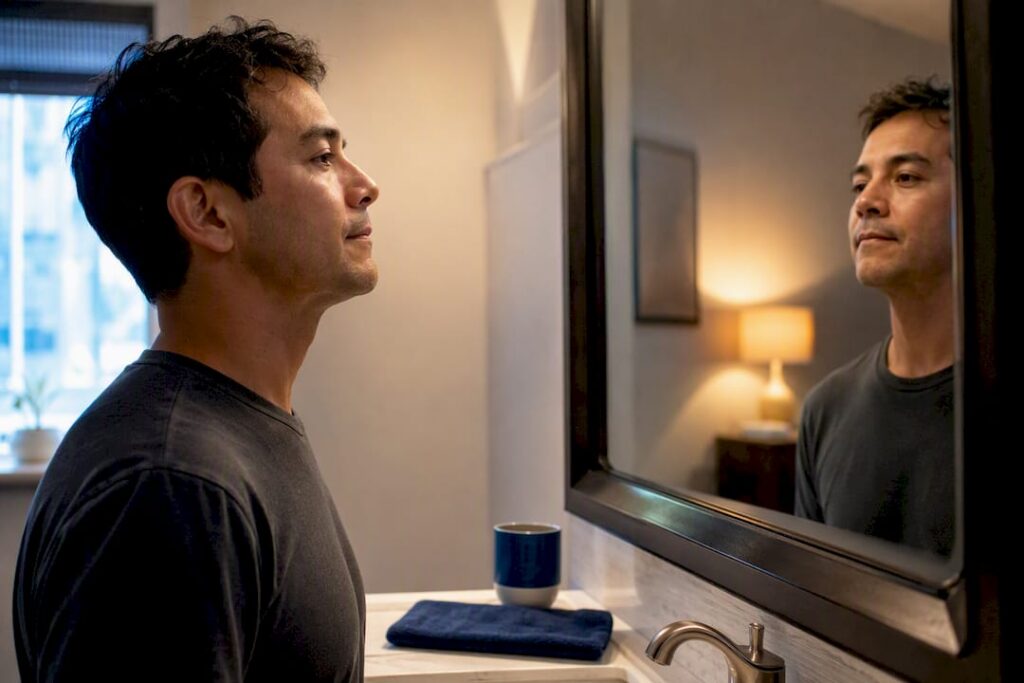
Targeted myofunctional therapy exercises strengthen the tongue, lips, and facial muscles to correct low tongue posture and mouth breathing, and a telemedicine-delivered program cut the apnea-hypopnea index by more than half in 53% of moderate OSA patients over three months. Most people practice 5 to 10 minutes, multiple times daily, and usually need several weeks of consistent practice before snoring and airway symptoms noticeably improve. Some practices build these exercises into broader airway care rather than treating them as a stand-alone fix.
TL;DR:
- A telemedicine program can reduce the apnea-hypopnea index by over 50% in half of moderate OSA cases within three months of consistent practice.
- Most exercises take 5 to 10 minutes daily for several weeks before snoring and airway symptoms improve noticeably.
- Proper technique, structural assessments, and supervision significantly increase the chances of successful muscle retraining and symptom relief.
- Exercises should be combined with structural corrections, like frenectomy or addressing obstructions, for severe cases to see meaningful results.
- Adherence, proper form, and professional guidance are essential to avoid reinforcing bad habits and to ensure long-term improvements.
Table of Contents
- Step-by-Step Myofunctional Therapy Exercises to Practice at Home
- How Myofunctional Therapy Improves Airway Function
- Building a Myofunctional Therapy Routine You’ll Actually Keep
- When to See a Trained Myofunctional Therapist
- How Bay Area Dental, Airway & Sleep Tailors Myofunctional Programs
- The Honest Take on Myofunctional Exercises
- Ready to Get a Personalized Airway Assessment?
- Sources
Step-by-Step Myofunctional Therapy Exercises to Practice at Home
These are the five exercises that show up in nearly every clinical protocol for tongue posture and airway training, including the exercise list Cleveland Clinic uses to describe orofacial myofunctional therapy. Do them in front of a mirror for the first two weeks. You cannot correct what you cannot see.
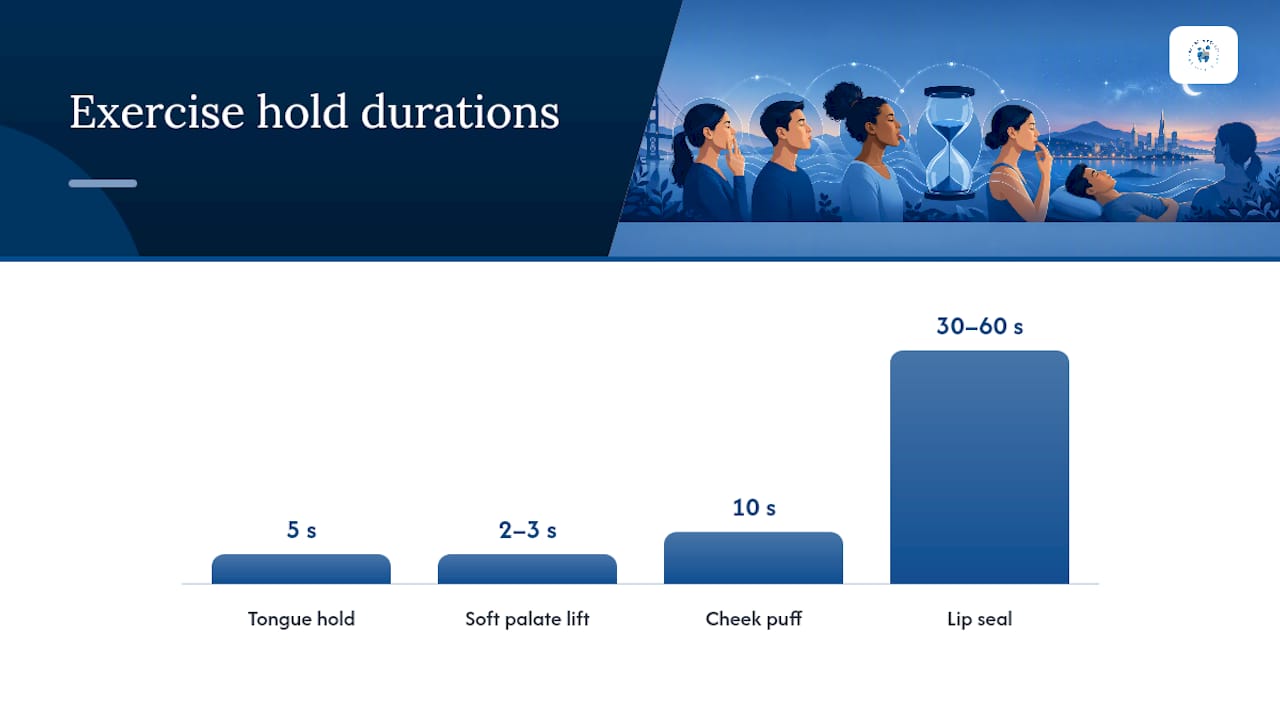
- Tongue-to-palate hold. Press the entire tongue, tip to back, flat against the roof of the mouth, just behind the front teeth. Create light suction, close your lips, and hold for 5 seconds. Release and repeat 10 times, 3 sets. The tip should never poke between your teeth.
- Tongue slide (tongue press). Starting from the same palate contact, slide the tongue backward along the roof of the mouth without breaking suction, then return to the front. Do 10 slow slides per set, 2 to 3 sets daily. This retrains the muscles that pull the tongue base forward and off the airway.
- Soft palate elevation. Say a hard “K” or “ahh” sound sharply, five times in a row, watching your uvula lift in the mirror. Hold the lifted position for 2 to 3 seconds on the last repetition. Three rounds a day is typical.
- Lip seal and resistance training. Hold a button, a lip trainer, or simply pinch a piece of paper between your closed lips for 30 to 60 seconds without letting your jaw help. A resting closed-mouth posture depends on lip strength as much as tongue position.
- Cheek and buccinator work. Puff both cheeks with air and hold for 10 seconds, or inflate a balloon slowly through pursed lips for several breaths. Balloon inflation appears repeatedly in clinical exercise lists because it builds the lateral pharyngeal wall tone that keeps the airway from collapsing during sleep.
Finish each session with controlled nasal breathing: inhale through the nose for 4 counts, exhale for 6, tongue resting on the palate the whole time. Ten breaths retrains the habit that daytime exercises are supposed to protect while you sleep.
The most common mistakes are clenching the jaw instead of using the tongue, letting the mouth fall open between reps, and placing the tongue tip against the teeth instead of the palate ridge. If your jaw is sore afterward, you’re doing the work with the wrong muscle group.
Pro Tip: Record yourself on your phone during the tongue-to-palate hold once a week. Comparing the clips is a far better proprioception check than trying to “feel” your own progress in the moment.
How Myofunctional Therapy Improves Airway Function
Low tongue posture, where the tongue rests on the floor of the mouth instead of the palate, lets the tongue base fall backward during sleep and narrow the airway. Myofunctional exercises rebuild the muscle tone and proprioception, the brain’s awareness of where the tongue actually sits, needed to hold a high resting posture automatically, not just when you’re thinking about it.
A three-month telemedicine program produced an AHI reduction over 50% in 53% of moderate OSA participants, and in 60% of severe OSA participants who paired the exercises with CPAP.
A broader state-of-the-art review backs the snoring and sleep-disordered breathing benefits but flags a real limitation: protocols vary widely between studies, and long-term follow-up data is thin. Exercises also don’t fix severe anatomical obstruction, like a badly narrowed airway or large tonsils, on their own. In those cases, myofunctional therapy works best as an add-on to CPAP or an oral appliance, not a replacement for either.
Building a Myofunctional Therapy Routine You’ll Actually Keep
A realistic starting program looks like this, based on typical clinical dosing:
- Weeks 1 to 2: 10 reps per exercise, 2 sets, twice daily, focused purely on correct tongue placement.
- Weeks 3 to 6: 10 reps, 3 sets, 2 to 3 times daily, adding longer palate holds (up to 10 seconds).
- Weeks 7 to 12: Combine exercises into a single 8 to 10 minute sequence, add resistance tools like a lip trainer, and reassess snoring or daytime fatigue.
Increase hold times or reps every 2 to 4 weeks, not sooner. Progressing before your form is consistent just reinforces bad habits faster.
Adherence beats intensity. A one-line log (“done, AM/PM”), a phone reminder tied to brushing your teeth, and a weekly mirror check catch drift before it becomes a wasted month. Some patients do brief telehealth check-ins with a therapist who reviews a recorded session and adjusts the plan from there.
When to See a Trained Myofunctional Therapist
Home practice is a reasonable starting point for mild snoring or a suspected low tongue posture. It is not a substitute for evaluation when any of these show up:
- Loud snoring paired with gasping, choking, or witnessed breathing pauses during sleep.
- Excessive daytime sleepiness despite a full night in bed.
- Persistent jaw pain, facial pain, or tongue soreness that doesn’t resolve within a few days of starting exercises.
- No improvement in snoring or tongue posture after 8 to 12 consistent weeks of practice.
Any of these warrants an assessment from a speech-language pathologist trained in orofacial myofunctional therapy, an ENT, or an airway-focused dental practice. Skip forceful or painful maneuvers entirely, and get a frenulum check before starting tongue-to-palate work if you suspect tongue-tie. Straining against a physical restriction just trains the wrong compensations.
How Bay Area Dental, Airway & Sleep Tailors Myofunctional Programs
A myofunctional plan built on a guess is a plan that stalls by week three. Bay Area Dental, Airway & Sleep starts with an oral exam, a resting tongue posture check, and a screen for structural limits like tongue-tie or a restricted lip frenulum before assigning a single exercise. Breathing pattern, mouth versus nasal, gets evaluated at the same visit.
Structural issues get addressed first. When indicated, a laser frenectomy or other adjustment clears the physical restriction so the muscle retraining that follows actually has room to work, and 3D imaging can support that assessment with a clearer picture of the airway itself.
Progress is ideally tracked through periodic check-ins rather than a one-and-done handout, with exercise sets adjusted as tongue posture and lip seal improve.
The Honest Take on Myofunctional Exercises
Most of what gets written about myofunctional therapy oversells the timeline and undersells the technique. People expect results in two weeks; the evidence points to months of consistent, correctly performed practice, and the research on neuromuscular retraining backs that up plainly. That’s not a flaw in the method. It’s how muscle memory actually works.
Where conventional advice falls shortest is form supervision. A list of five exercises is easy to find online; knowing whether your tongue tip is drifting forward on rep seven is not something a blog post can catch. The state-of-the-art review found supervised programs consistently outperform self-guided ones, and that tracks with what shows up in clinic: patients doing the right exercise the wrong way for months, wondering why nothing changed.
If you’re starting from scratch, prioritize an honest structural screen before you prioritize the exercises themselves. Tongue-tie, jaw position, and nasal obstruction can all quietly cap how much any home program can accomplish, no matter how disciplined the practice.
— Admin
Ready to Get a Personalized Airway Assessment?
A tailored approach is the alternative to guessing your way through a generic exercise list. A first visit ideally includes a real structural screen, tongue posture check, and breathing pattern evaluation, so your program targets what’s actually limiting your airway instead of a set of exercises copied from a printout.
A comprehensive first appointment typically covers an oral and airway exam, a discussion of your snoring or sleep symptoms, and a customized exercise plan built around what the exam finds, sometimes alongside orthodontic or frenectomy referrals when structural issues need addressing first. Everything ideally integrates with broader airway and sleep care rather than existing as a separate track. If you’ve been practicing generic tongue exercises for weeks with no change, or you snore loudly and want a real answer instead of another app, schedule an airway evaluation and get a plan built around your own anatomy.