

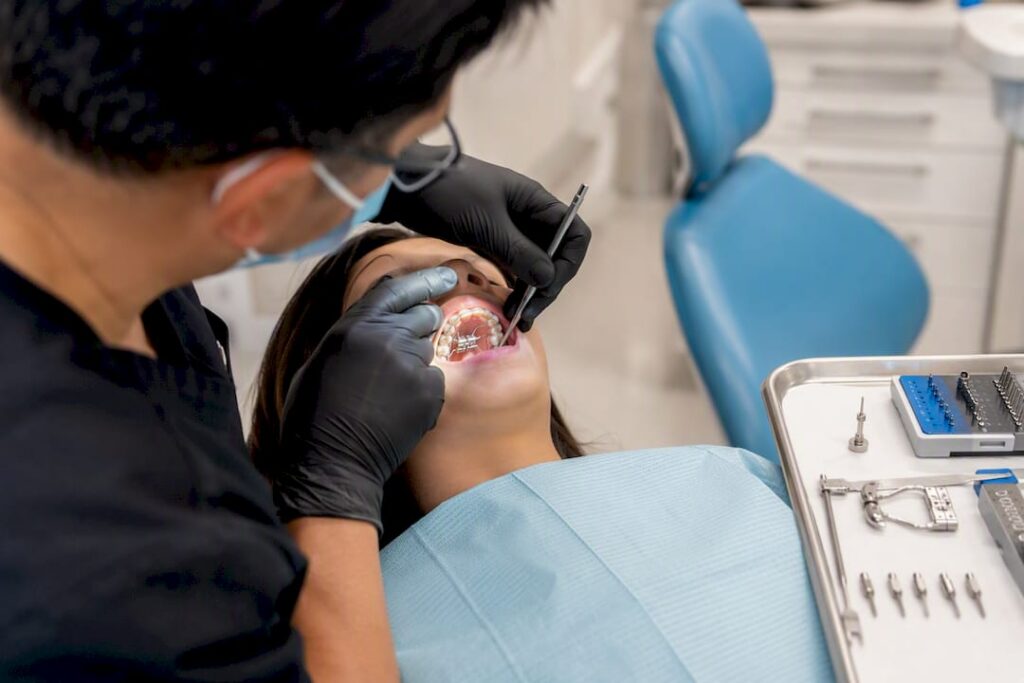
Adult palate expansion is possible for most patients, and non-surgical, miniscrew-assisted expansion is typically the first approach a clinician will consider. Whether it succeeds depends on how your mid-palatal suture responds on CBCT imaging: if the suture still shows some separability, non-surgical expansion is attempted; if it’s densely fused, surgically assisted expansion (SARPE) becomes the more reliable route. There’s no universal answer here, only an individualized read of your anatomy.
TL;DR:
- Miniscrew-assisted expansion achieves true skeletal widening in adults when CBCT shows a separable suture and adequate bone quality.
- SARPE is recommended for cases with heavily fused sutures or moderate to severe skeletal constriction, especially if imaging indicates high resistance.
- Rapid expansion protocols may increase hardware and bone stress, while force-controlled slow expansion offers higher efficiency and more stable results.
- Proper candidate selection relies on detailed CBCT imaging, not age, and treatment plans should be tailored based on individual suture and bone assessments.
Table of Contents
- Non-Surgical Palatal Expansion Vs. SARPE: What’s the Difference?
- How Do Clinicians Decide If You’re a Candidate?
- What Should You Expect: Timeline, Discomfort, and Risk?
- Rapid Vs. Slow Activation: Which Protocol Is Safer for Adults?
- How Do You Choose the Right Provider and Approach?
- How Bay Area Dental, Airway & Sleep Approaches Adult Cases
- What Happens When You Contact Us for an Evaluation?
- Key Studies and Clinical Resources
- Sources
Non-Surgical Palatal Expansion Vs. SARPE: What’s the Difference?
Once your growth plates fuse, the bone structure of the palate behaves very differently than it did in childhood, which is why “just wear an expander” doesn’t cut it for most adults.
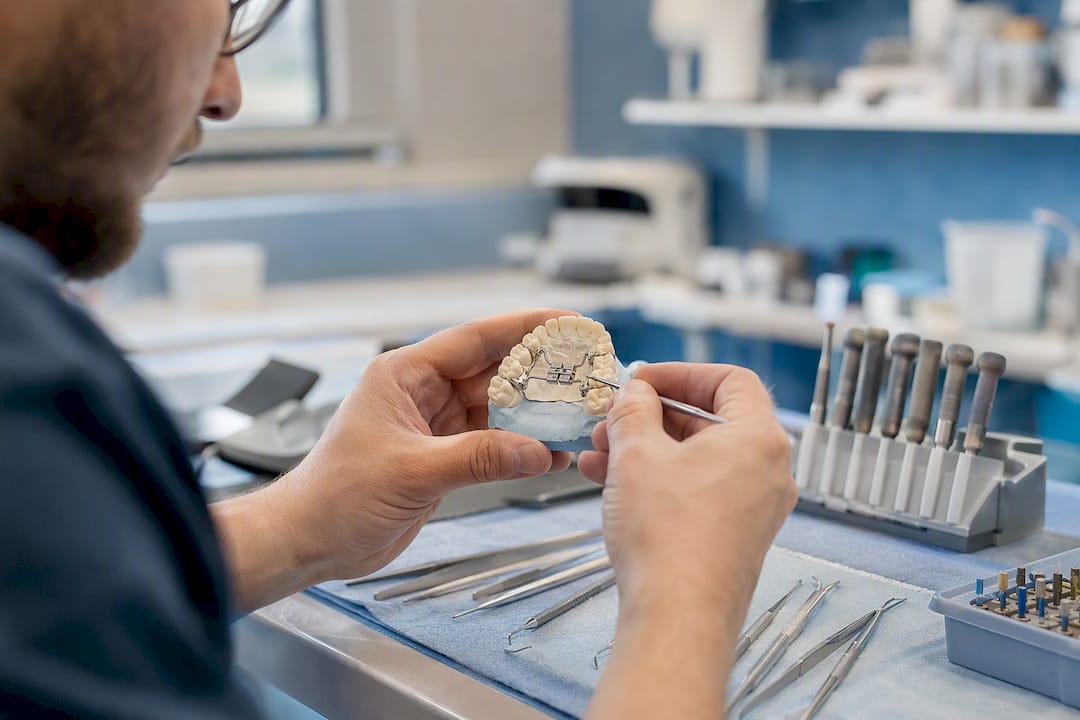
MARPE, MAPE, and MASPE (miniscrew-assisted rapid/maxillary/skeletal palatal expansion) are largely the same concept described by different acronyms depending on the research group. All three anchor an expansion device directly into bone using temporary miniscrews, bypassing the teeth almost entirely. This matters because a comparative review of expansion methods found that bone-anchored appliances achieve real skeletal widening in adults, where conventional tooth-borne rapid maxillary expansion (RME) mostly tips teeth outward without meaningfully separating the suture.
SARPE (surgically assisted rapid palatal expansion) pairs a small surgical release of resistant bone with an expansion appliance. It’s not a bigger version of MARPE. It’s a different tool for a different problem: sutures too calcified for miniscrews alone to separate.
Here’s how the decision usually breaks down:
- Conventional tooth-borne RME: rarely recommended alone in adults; produces dental tipping, not skeletal change.
- MARPE/MAPE/MASPE: first-line when CBCT shows a suture with realistic separability and adequate bone for anchorage.
- SARPE: reserved for moderate to severe skeletal constriction or when imaging shows heavy suture resistance, per Cleveland Clinic’s guidance on palate expanders.
How Do Clinicians Decide If You’re a Candidate?
Candidacy isn’t a birthday number. It’s a bone and suture question, and the only way to answer it accurately is with imaging, not a ruler and a hunch.
- CBCT scan first. Cone-beam CT reveals suture morphology, bone thickness available for miniscrew anchorage, and proximity to nasal and sinus structures, all of which shape whether an appliance can be placed safely and effectively.
- Suture staging over age. A narrative review on adult maxillary expansion outcomes makes clear that chronological age is a weak predictor on its own. Suture maturation stage and bone density explain far more of the variation in who responds well and who doesn’t.
- Placement and bone quality checks. The same review notes that positioning the appliance posterior to the palatal rugae, in bone with strong quality for bicortical screw engagement, meaningfully lowers failure rates.
- Periodontal and dental workup. Gum health, existing tooth alignment, and overall treatment goals (airway improvement, crowding relief, or bite correction) all factor into the plan.
- Team involvement. A well-run case usually involves an orthodontist and, when surgery is on the table, an oral and maxillofacial surgeon coordinating directly on the CBCT findings.
What Should You Expect: Timeline, Discomfort, and Risk?
Adult treatment moves slower than it did for your kid’s expander, and the numbers back that up. Expect the active phase to run anywhere from a few weeks to several months, with total treatment, including retention, often stretching close to a year.
By the numbers: a 2021 study on non-surgical adult palatal expansion using a force-controlled polycyclic protocol reported an 84.4% success rate across patients aged 18 to 49, with complications occurring in 18.5% of cases. Age itself significantly raised the odds of running into a complication.
That’s a solid success rate, but it’s not a coin flip you can ignore. Common issues include:
- Miniscrew loosening or loss of anchorage
- Soft tissue irritation around the screws
- Discomfort during activation, typically manageable with over-the-counter pain relief
- Uneven expansion, often described as V-shaped, with more opening at the front of the palate than the back
That last pattern shows up consistently in CBCT follow-up studies and matters for planning, since it affects how much correction happens near the front teeth versus the molars. If you notice persistent screw mobility, worsening pain, or signs of infection around an anchorage site, that’s a call-your-clinician moment, not a wait-and-see one.
Rapid Vs. Slow Activation: Which Protocol Is Safer for Adults?
How fast you turn the screw matters almost as much as the appliance itself. Rapid activation protocols expand the suture quickly, which can work well but carries a higher mechanical load on both the hardware and the surrounding bone.
Force-controlled polycyclic (FCPC) protocols take a slower, staged approach instead, applying controlled force and letting the suture adapt between activation cycles rather than forcing separation all at once. A 2024 retrospective CBCT comparison found that FCPC slow protocols achieved 84 to 89% efficiency (measured as M.O.R.E., or midline opening relative to expansion) while producing 50 to 60% less pterygoid process deformation than rapid MARPE activation.
- Bone-borne appliances: anchor entirely to bone, deliver the most skeletal change, best suited to FCPC-style pacing.
- Hybrid appliances: combine tooth and bone anchorage, splitting forces between both.
- Tooth-borne appliances: rely on teeth alone, prone to dental tipping rather than skeletal widening in adults.
Pro Tip: Ask your provider directly whether they use a rapid or force-controlled slow activation schedule. The answer tells you a lot about how they’re managing your risk of hardware complications versus how quickly they’re trying to move your palate.
Retention after slower protocols tends to be more stable, since the suture has had time to reorganize rather than being stretched past its adaptive limit.
How Do You Choose the Right Provider and Approach?
A good consultation should feel like a diagnostic conversation, not a sales pitch. Walk in ready to ask pointed questions.
- Has a CBCT scan been taken, and what does it show about your suture’s separability? No scan, no real answer.
- What’s the activation protocol, rapid or force-controlled slow, and why that choice for your case specifically?
- What happens if non-surgical expansion doesn’t achieve the target, is there a surgical contingency plan?
- How is retention managed after active expansion ends?
- What’s the provider’s experience with adult cases specifically, not just adolescent orthodontics?
Red flags worth noticing: a recommendation made without imaging, a one-size-fits-all appliance regardless of your suture status, or a rushed answer to “what if this doesn’t work.”
How Bay Area Dental, Airway & Sleep Approaches Adult Cases
Every adult expansion case at Bay Area Dental, Airway & Sleep starts with 3D imaging, not a generic protocol. We pair that imaging with an airway and myofunctional evaluation, since a narrow palate often ties into breathing and tongue posture issues that expansion alone won’t fix. When surgery is the right call, we coordinate directly with oral surgeons rather than leaving that handoff to chance. Laser treatment options round out care where soft tissue needs attention alongside the skeletal work.
— Admin
What Happens When You Contact Us for an Evaluation?
If a narrow palate has been flagged by another provider, or you suspect one yourself from crowding, airway issues, or a narrow smile, the first visit at Bay Area Dental, Airway & Sleep starts with a full records review and a CBCT scan. From there, we walk through what your suture status actually supports: non-surgical MARPE or MAPE, a coordinated SARPE referral if the bone calls for it, and myofunctional therapy where tongue posture or breathing patterns are part of the picture.

Unlike a general orthodontic office running the same tooth-borne expander for every patient, our approach is built around imaging first, appliance second. That order matters because it’s the difference between guessing and knowing whether your suture can respond non-surgically at all. If you’re ready to find out where you stand, schedule a consultation with Bay Area Dental, Airway & Sleep and bring your questions about imaging, activation protocol, and retention. We’ll walk through the CBCT findings with you before recommending anything.
Key Studies and Clinical Resources
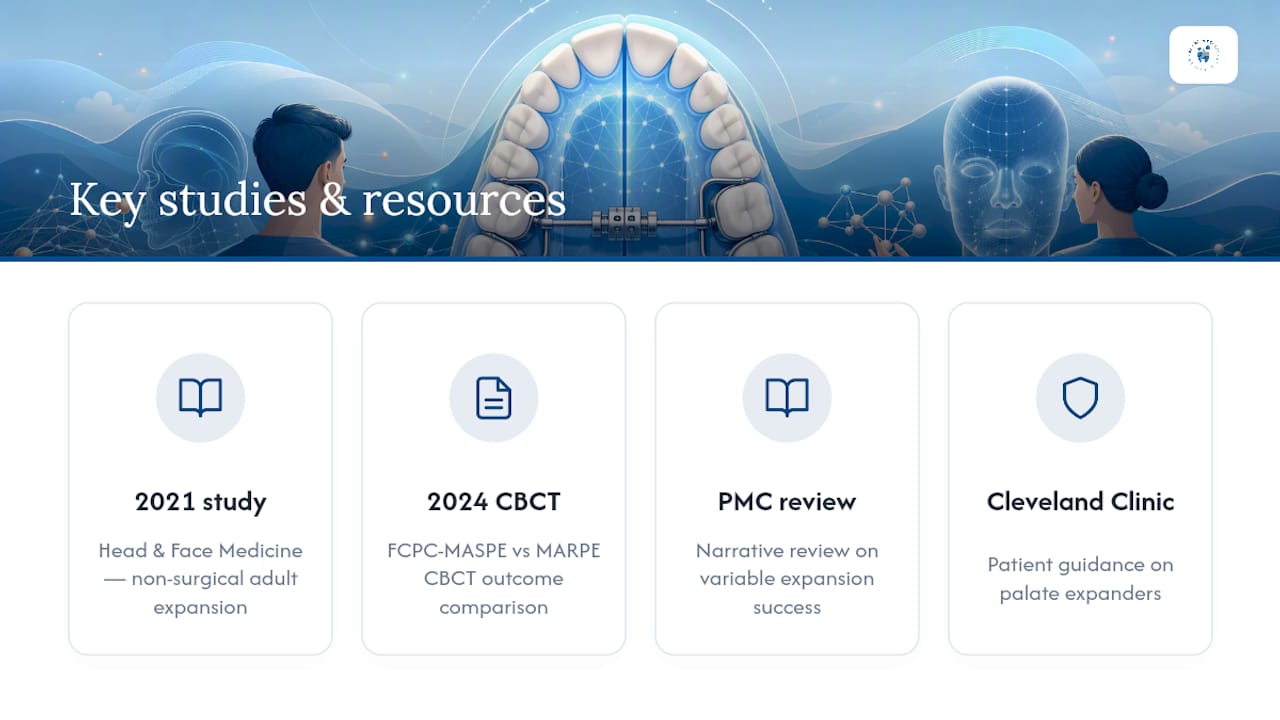
For readers who want to go deeper, the 2021 Head & Face Medicine study on non-surgical adult expansion and the 2024 FCPC-MASPE versus MARPE CBCT comparison offer the most detailed outcome data available. The PMC narrative review on variable expansion success and Cleveland Clinic’s patient guidance on palate expanders round out a solid starting point for understanding candidacy and realistic timelines.
This article is general information, not a substitute for advice from a qualified doctor. Consult a qualified healthcare professional about your own circumstances before acting on anything here.