
Airway orthodontics uses growth-guiding appliances, myofunctional therapy, and targeted procedures to help the jaws and airway develop with better breathing and sleep in mind, not just straighter teeth. It works best as one part of a medical team’s plan. If you or your child show signs of disordered breathing, snoring, or restless sleep, the right next step is a screening conversation with a dentist or orthodontist trained in airway issues, followed by physician referral for formal testing such as polysomnography if warranted.
TL;DR:
- Airway orthodontics emphasizes growth guidance and airway support over traditional alignment, with techniques like maxillary expansion and myofunctional therapy aimed at improving breathing.
- Benefits are most promising in children with documented nasal obstruction, mouth breathing, or narrow palates, especially when still within a growth window; adults might qualify for mandibular advancement devices instead.
- Evidence supports certain interventions like maxillary expansion and mandibular advancement appliances for mild to moderate sleep disorders, but no treatment is proven as a standalone cure for sleep-disordered breathing.
- Diagnosis requires proper screening, referral, and polysomnography testing, with treatment plans based on severity, growth potential, and confirmed anatomical issues; imaging results alone don’t predict breathing improvements.
- Risks include relapse after expansion, bite shifts from appliances, and overpromising results, so treatment should complement physician-led diagnosis rather than replace comprehensive sleep assessments.
Table of Contents
- What Is Airway Orthodontics and How Does It Differ From Traditional Braces?
- Who Might Benefit? Warning Signs in Children and Adults
- Treatments and the Evidence: What’s Solid and What’s Still Uncertain
- How Does Diagnosis Actually Happen? The Screening-to-Sleep-Study Pathway
- What to Expect: Timeline, Outcomes, Risks, and Paying for It
- Inside a Multidisciplinary Airway Practice: How Bay Area Dental, Airway & Sleep Approaches This
- Who Else Belongs on an Airway Care Team?
- Who Is a Good Candidate for Airway-Focused Treatment?
- What Can Go Wrong? Risks and Limits Worth Knowing Upfront
- How Do the Main Techniques Compare on Actual Evidence?
- Why Airway Problems Affect More Than Sleep
- The Honest Take on Airway Orthodontics
- Get an Airway Evaluation That Coordinates With Your Whole Care Team
- Sources
What Is Airway Orthodontics and How Does It Differ From Traditional Braces?
Traditional orthodontics is mostly about alignment: straight teeth, a good bite, a symmetrical smile. Airway-focused orthodontics starts from a different question: is the mouth and jaw structure supporting or working against normal breathing and tongue posture? The goal is to guide facial growth, widen a constricted palate, and support nasal breathing rather than treat crowding as a cosmetic problem alone.
The techniques overlap with conventional care but get used with a different intent:
- Rapid maxillary expansion (RME): widens a narrow upper jaw, which can increase nasal airway volume in growing children.
- Growth-guiding appliances: encourage forward jaw development during childhood growth spurts.
- Myofunctional therapy: retrains tongue posture and swallowing patterns that affect airway space.
- Frenectomy: releases a restrictive tongue or lip tie that limits tongue mobility and proper oral rest posture.
- Mandibular advancement appliances: reposition the lower jaw forward, sometimes used in mild adult sleep-disordered breathing.
- Orthognathic surgery: considered for adults with significant skeletal deficiencies once growth has finished.
Airway-focused practitioners tend to favor expansion over extraction. Pulling four premolars to relieve crowding, a common approach for decades, can narrow the arch and the tongue space behind it. Airway-minded treatment planning leans toward growing the arches instead of shrinking them.
Who Might Benefit? Warning Signs in Children and Adults
Not every crooked tooth signals an airway problem, and not every snorer needs a jaw appliance. Certain patterns are worth taking seriously.
- Mouth breathing during the day or sleep. Persistent open-mouth posture in a child, especially past toddler age, often points to nasal obstruction or low tongue posture.
- Loud, habitual snoring. In kids, this is never “just normal.” In adults, it’s the most common visible symptom of sleep-disordered breathing.
- Restless or fragmented sleep. Frequent position changes, sweating, or sleepwalking in children can trace back to airway effort during sleep.
- Witnessed pauses in breathing or gasping. This applies to both children and adults and warrants prompt medical evaluation, not a wait-and-see approach.
- Daytime sleepiness or behavioral changes. Hyperactivity and attention problems in kids sometimes mask underlying sleep fragmentation; in adults, it shows up as fatigue and mood shifts.
- Feeding difficulties in infants. Poor latch, prolonged feeding times, or slow weight gain can relate to tongue mobility and airway anatomy.
A narrow palate or receding chin raises suspicion, but jaw shape alone can’t diagnose obstructive sleep apnea (OSA). Screening tools exist to flag risk and guide the referral decision, not to replace a diagnosis.
Treatments and the Evidence: What’s Solid and What’s Still Uncertain
Several interventions show up repeatedly in airway-focused treatment plans, each with a different level of supporting evidence.
- Rapid maxillary expansion widens the palate and can increase nasal airway dimensions on imaging, particularly in growing children with a genuinely narrow arch.
- Mandibular advancement appliances (MADs) move the lower jaw forward and are sometimes used for mild to moderate adult OSA, usually when CPAP isn’t tolerated.
- Myofunctional therapy addresses tongue posture and can support other treatments, though it rarely works as a standalone fix for significant airway obstruction.
- Frenectomy releases a tongue or lip tie limiting oral function, often paired with myofunctional therapy afterward.
- Maxillomandibular advancement surgery is reserved for adults with severe skeletal issues and confirmed moderate to severe OSA that hasn’t responded to other treatment.
Pro Tip: Ask any provider recommending an airway appliance whether the goal is a morphologic change (a wider palate on an X-ray) or a functional change (measured improvement in breathing during sleep). They are not the same thing, and a good provider will explain the difference without hesitating.
Here’s where expectations need tempering. A systematic review of combined mandibular advancement and maxillary expansion in children found possible reductions in apnea-hypopnea index and improved oxygenation, but the researchers flagged a small, methodologically limited evidence base and called for larger randomized trials before drawing firm conclusions. Separately, a review distinguishing morphologic and functional airway outcomes points out that a wider airway on a scan doesn’t reliably predict better breathing during sleep. Imaging gains and clinical improvement are related but not interchangeable.
The American Association of Orthodontists’ white paper on airway health states plainly that current evidence does not support orthodontic treatment as a standalone cure for sleep-disordered breathing. The clinical takeaway: expansion or myofunctional work can help specific anatomical problems, like a genuinely constricted palate, but none of it substitutes for physician-led diagnosis or first-line treatment of confirmed OSA.
How Does Diagnosis Actually Happen? The Screening-to-Sleep-Study Pathway
Getting from “something seems off” to an actual diagnosis follows a fairly predictable sequence.
- Initial screening. Dental providers often use structured questionnaires: STOP-Bang for adults, the Pediatric Sleep Questionnaire for children. These flag risk; they don’t diagnose anything.
- Referral trigger. A positive screen, witnessed apneas, or persistent symptoms should prompt referral to an ENT, pediatrician, or sleep medicine physician. Orthodontists who screen for OSA are expected to refer rather than diagnose, a distinction that matters because misdiagnosis or delayed referral can leave real breathing problems untreated.
- Definitive testing. Polysomnography (PSG) remains the diagnostic gold standard for OSA, tracking brain activity, oxygen levels, and breathing effort overnight in a sleep lab. Home sleep apnea testing (HSAT), also called out-of-center sleep testing, works for selected adults with a straightforward clinical picture, but it’s less comprehensive than in-lab PSG.
- Treatment planning based on results. Severity findings from PSG shape whether the plan involves CPAP, an oral appliance, surgery, or a combination, with orthodontic intervention as one contributing piece rather than the whole strategy.
What to Expect: Timeline, Outcomes, Risks, and Paying for It
Expansion appliances in children typically run 6 to 12 months of active widening, followed by a retention phase to hold the new arch shape while growth continues. Functional jaw appliances for growth guidance often need 12 to 18 months, timed to a child’s natural growth spurts. This is why the pediatric years, roughly ages 7 to 9, matter so much: the palate is still responsive to expansion in a way it simply isn’t once growth plates fuse.

Adults considering mandibular advancement appliances should expect an adjustment period of weeks to months, with follow-up sleep testing to confirm the device is actually reducing apnea events, not just reducing snoring volume.
Realistic risk awareness matters here:
- Long-term MAD use can shift bite alignment over years, sometimes requiring a dental follow-up plan of its own.
- Expansion treated too early or without adequate retention can partially relapse as a child continues growing.
- Respiratory outcomes vary person to person; a device that helps one patient’s AHI significantly may do far less for another with a different anatomical picture.
On cost: many airway-related procedures straddle medical and dental insurance, especially frenectomy and appliance therapy tied to a diagnosed sleep disorder. Ask your provider for documentation, including screening results and any physician referral, before starting treatment. That paperwork often determines whether a claim gets processed as medical rather than dental, which can change your out-of-pocket cost substantially.
Inside a Multidisciplinary Airway Practice: How Bay Area Dental, Airway & Sleep Approaches This
Bay Area Dental, Airway & Sleep, based in Fremont, treats airway concerns as a whole-body issue rather than an isolated dental one. The practice uses 3D imaging to map airway anatomy in real detail, laser frenectomy for infants, children, and adults with restrictive tongue or lip ties, and myofunctional therapy to retrain oral posture after structural treatment.
What sets a practice like this apart isn’t any single tool. It’s the coordination: imaging findings get discussed alongside referrals to ENT and sleep medicine when a patient’s history suggests something beyond what a dental team should manage alone. The clinic also serves Deaf patients with tailored communication support, a detail that matters because airway evaluation depends heavily on a patient accurately describing symptoms.
If you’re preparing for a first evaluation, bring a symptom history (snoring frequency, witnessed pauses, daytime fatigue), any prior sleep study results, and a list of questions about what the practice screens for versus what it refers out. A good first visit should leave you clear on both.
Who Else Belongs on an Airway Care Team?
ENT specialists and sleep physicians get most of the attention in airway conversations, but they’re rarely the whole team. Pulmonologists step in when breathing issues extend beyond upper airway obstruction into lung function itself, particularly relevant for patients with asthma, chronic congestion, or complex pediatric cases where sleep-disordered breathing overlaps with respiratory disease.
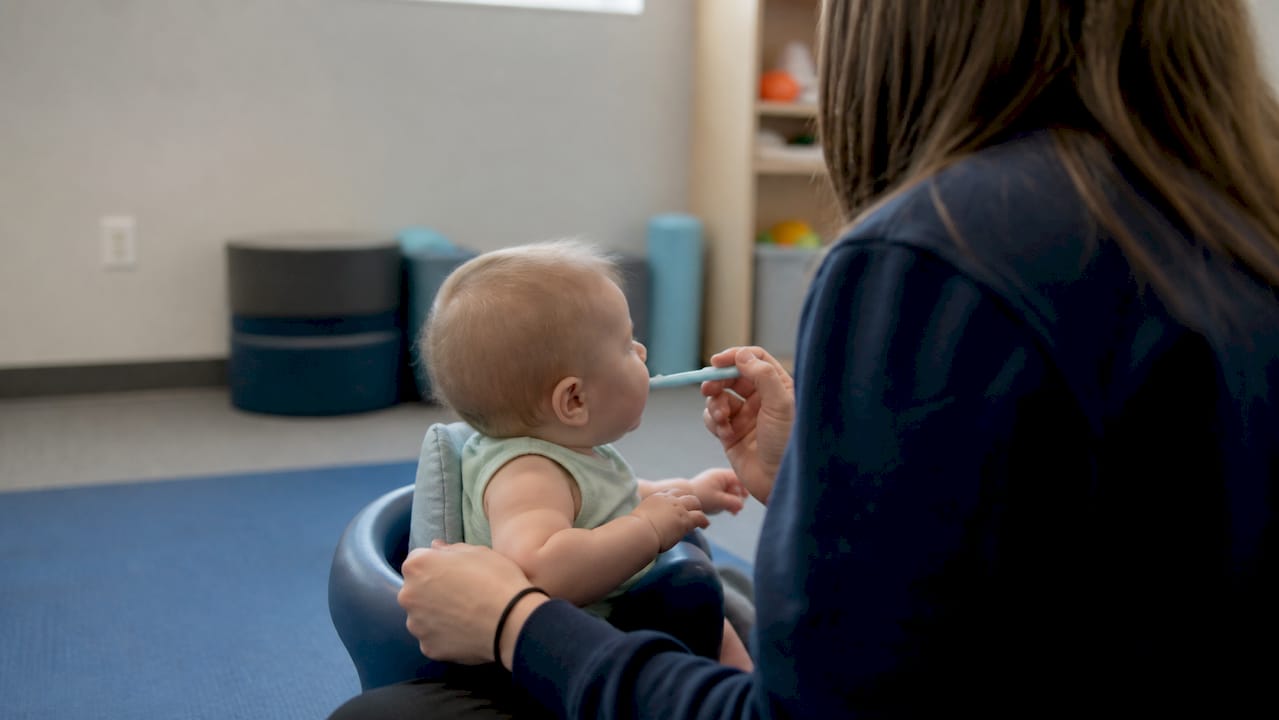
Speech-language pathologists play a bigger role than most patients expect. Tongue posture, swallowing mechanics, and oral motor function directly affect airway space, and a speech therapist trained in orofunctional issues often works alongside myofunctional therapy to reinforce correct resting tongue position between orthodontic appointments. For infants recovering from a frenectomy, a speech therapist or lactation consultant frequently guides post-procedure exercises to make sure the release actually translates into better feeding and tongue mobility rather than just a physical change with no functional follow-through.
Registered dietitians occasionally enter the picture too, particularly for children whose feeding difficulties or growth concerns tie back to airway restriction. And for adults being evaluated for surgical airway correction, an oral and maxillofacial surgeon works in tandem with the sleep physician to determine whether the case truly warrants a surgical approach or whether appliance therapy is sufficient.
The pattern across all of these roles is the same: no single specialist owns the airway. A dentist or orthodontist who flags a concern, refers appropriately, and stays in the loop as treatment progresses is doing the job correctly. One who tries to manage every piece independently is stepping outside their scope, and it’s fair to ask providers directly how they coordinate with other specialists.
Who Is a Good Candidate for Airway-Focused Treatment?
Not every patient with crowded teeth or occasional snoring needs airway-focused intervention, and treating candidacy too broadly is one of the more common missteps in this field. Strong candidates for orthodontic-led approaches usually share a few traits: a measurably narrow maxilla confirmed through clinical exam and imaging, documented mouth breathing or nasal obstruction, and, for children, enough remaining growth potential to benefit from expansion or growth-guidance appliances.
Age matters enormously here. A seven-year-old with a constricted palate and adenotonsillar issues is a very different case than a 45-year-old with the same palate shape and decades of skeletal maturity behind it. The younger patient has a growth window to work with; the older one may need surgical correction or a mandibular advancement device instead of appliance therapy aimed at reshaping bone that’s no longer responsive.
Symptom severity and confirmed diagnosis also factor in. A child with mild snoring and no other red flags might do well with watchful monitoring and myofunctional exercises. A child with confirmed moderate OSA on a sleep study, documented growth delay, or significant tonsil and adenoid involvement usually needs a coordinated plan involving ENT alongside any orthodontic component.
Adults are more likely to be candidates for adjunctive appliance therapy, MADs specifically, when CPAP has failed or proven intolerable, and when a sleep physician has confirmed the severity level is appropriate for an oral device rather than requiring more aggressive treatment. Selection isn’t about who wants treatment. It’s about who has anatomy, symptoms, and a confirmed diagnosis that actually align with what a given intervention can realistically address.
What Can Go Wrong? Risks and Limits Worth Knowing Upfront
Airway orthodontics carries real limitations that deserve equal weight to its benefits. Expansion appliances used outside an appropriate growth window can produce disappointing or unstable results, and relapse is a genuine risk if retention protocols aren’t followed carefully after active treatment ends.
Mandibular advancement appliances, while helpful for some adults, can cause progressive bite changes over years of nightly use. Some patients develop a shifted bite relationship that requires separate dental correction down the line, a tradeoff worth discussing honestly before committing to years of nightly wear.
Myofunctional therapy demands consistency. Skipping exercises or stopping early often means the tongue posture and swallowing pattern revert, undoing gains made through appliance therapy. It’s not a one-time fix; it’s closer to physical therapy for the mouth, requiring ongoing effort.
Perhaps the most important limitation is the one the AAO addresses directly: orthodontic intervention should not be assumed to prevent or cure sleep-disordered breathing, and treating it as a guaranteed fix sets patients and parents up for disappointment. Some children with treated palatal constriction still show sleep-disordered breathing afterward, particularly when adenotonsillar tissue or other anatomical factors are contributing alongside the jaw structure. That’s exactly why physician involvement and follow-up sleep testing matter, not as a formality but as the actual measure of whether treatment worked.
How Do the Main Techniques Compare on Actual Evidence?
Comparing airway orthodontic techniques head-to-head is harder than marketing materials suggest, mostly because the research base varies wildly by intervention. Rapid maxillary expansion has the longest track record and the most imaging data showing increased nasal airway volume, but morphologic gains on a scan don’t reliably predict improved breathing during sleep, which limits how confidently anyone can claim RME “treats” sleep apnea on its own.
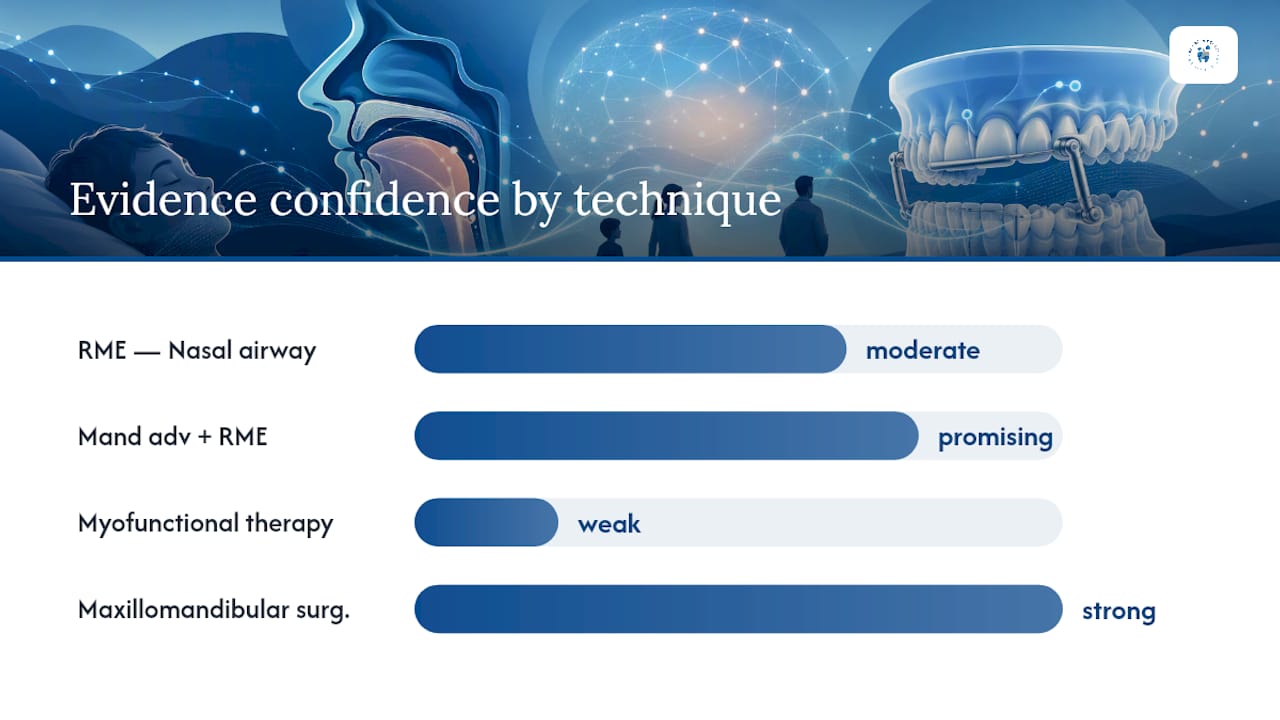
Combined mandibular advancement with maxillary expansion in children shows more promising functional signals. The systematic review covering this combined approach reported measurable reductions in apnea-hypopnea index and improved oxygenation in some pediatric cohorts, an encouraging early signal, but the reviewers were explicit that study quality and sample sizes remain limited, and they called for larger, better-controlled trials before treating this as established practice.
Myofunctional therapy has the weakest standalone evidence for resolving diagnosed OSA, though it’s frequently used as a supporting therapy rather than a primary treatment, which makes isolating its independent effect difficult in research.
Surgical approaches, maxillomandibular advancement specifically, show the strongest functional outcomes in adults with confirmed moderate to severe OSA, but that strength comes with substantially higher invasiveness and recovery demands compared to appliance-based options.
The honest comparison isn’t “which technique wins.” It’s that each technique addresses a different anatomical or functional problem, and the evidence quality behind each varies enough that no single approach should be presented as a universal solution.
Why Airway Problems Affect More Than Sleep
Poor sleep from airway obstruction rarely stays contained to nighttime hours. In children, fragmented sleep disrupts growth hormone release, which happens predominantly during deep sleep stages, and can show up as slower growth trajectories or unexplained plateaus on a pediatrician’s growth chart. Chronic mouth breathing also tends to affect facial development over years, sometimes contributing to a longer, narrower facial structure and altered dental arch shape, exactly the kind of pattern that draws airway-focused orthodontists’ attention in the first place.
Behaviorally, the overlap with attention and mood issues is significant enough that pediatric sleep-disordered breathing sometimes gets misread as attention-deficit disorder. Children with chronic sleep fragmentation from airway obstruction can present with hyperactivity, irritability, and difficulty concentrating in school, symptoms that improve for some kids once the underlying breathing issue is properly treated and sleep quality recovers.
Adults face a parallel set of consequences: daytime fatigue, elevated cardiovascular strain from repeated oxygen desaturation events, and mood or cognitive effects tied to chronically disrupted sleep architecture. None of this means every tired, distractible kid or every fatigued adult has an airway problem. But when snoring, mouth breathing, or witnessed breathing pauses accompany these broader symptoms, the airway deserves a genuine look rather than dismissal as an unrelated issue. The connection between breathing and whole-body development is well established even where the specific treatment evidence for orthodontic intervention is still catching up.
The Honest Take on Airway Orthodontics
The biggest gap in this field isn’t the treatments themselves. It’s the confidence with which some providers market them. Expansion appliances and myofunctional therapy can genuinely help specific anatomical problems, but the pattern of overselling morphologic changes as functional cures has done real damage to the specialty’s credibility.
What the evidence actually supports is narrower and more useful than the marketing: screen carefully, refer honestly, and treat the anatomy you can actually change while leaving diagnosis and severity assessment to physicians equipped to make that call. The conventional advice, “get an airway appliance and your child’s sleep issues will resolve,” oversimplifies a problem that’s often multifactorial, involving tonsils, adenoids, nasal anatomy, and jaw structure all at once.
If you take one thing from this, prioritize the sleep study over the appliance. A confirmed diagnosis tells you which interventions actually apply to your situation. Skipping that step and going straight to a device, however well-intentioned the provider, means treating a guess instead of a diagnosis.
— Admin
Get an Airway Evaluation That Coordinates With Your Whole Care Team
If you’ve read this far because something about your child’s snoring, your own fatigue, or a persistent mouth-breathing habit doesn’t sit right, the next move isn’t guessing at appliances online. It’s getting evaluated by a practice that screens properly and knows when to bring in outside specialists instead of overreaching.
Bay Area Dental, Airway & Sleep built its airway program around that exact coordination: 3D imaging to assess anatomy, laser frenectomy for tongue and lip ties, myofunctional therapy to retrain posture, and direct referral pathways to ENT and sleep medicine when a case calls for it. The practice also serves patients other offices often underserve, including the Deaf community, with communication support built into the evaluation process from the first visit.
If breathing, sleep, or jaw development concerns have been on your mind for you or your child, schedule an airway evaluation with Bay Area Dental, Airway & Sleep and get a clear, physician-coordinated read on what’s actually going on before committing to any treatment path.
This article is general information, not a substitute for advice from a qualified doctor. Consult a qualified healthcare professional about your own circumstances before acting on anything here.