

If you have looked under your baby’s upper lip and wondered whether that band of tissue is a lip tie or completely normal, you are not alone. It is one of the most common questions new parents ask. This guide shows you what a normal upper lip looks like, what a lip tie looks like, and how to tell them apart, so you know whether an evaluation is worth booking.

What is normal, and what is a lip tie?
Every person has a small band of tissue called the labial frenulum that connects the inside of the upper lip to the gums. That band is normal. It only becomes a lip tie when it is unusually short, thick, or attached low on the gum, to the point that it limits how freely the upper lip can lift and flange outward.
So the question is rarely “is there a frenulum” (there always is) but “is this frenulum restricting movement.” That distinction is what separates normal from a lip tie.
What a normal upper lip looks like
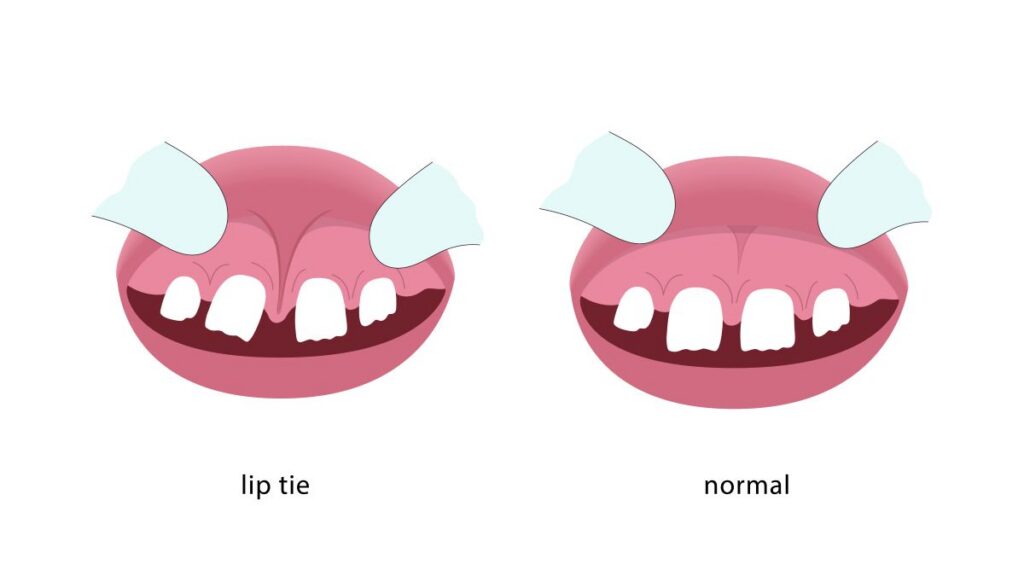
In a normal upper lip, the frenulum is thin and attaches higher up, away from the gum ridge. The lip lifts and curls outward easily, which lets a baby form a wide, deep seal during feeding. When you gently lift the lip, it moves freely and the tissue does not blanch white or tug hard on the gum.
Signs the upper lip is normal
The lip flanges outward comfortably, there is no deep gap forced between the front teeth or gum pads, feeding is comfortable and efficient, and lifting the lip does not cause obvious tension or a hard tethered band.
What a lip tie looks like
A lip tie appears as a thicker or tighter band that anchors the lip close to or over the gum ridge. When you lift the lip, it does not curl up easily, the tissue may look taut or turn pale from the tension, and in some cases the band extends down between the two front teeth.
Signs that may point to a lip tie
The upper lip does not curl upward easily, there is a visible thick or taut band beneath the lip, feeding involves clicking sounds, leaking milk, or trouble staying latched, and there may be a gap forming between the upper front teeth as they come in.
Lip tie vs normal: a quick visual comparison
Attachment point. Normal attaches higher on the gum; a lip tie attaches low, near or over the gum ridge.
Thickness. Normal is a thin membrane; a lip tie is often thicker or more fibrous.
Lip movement. A normal lip flanges out freely; a tied lip resists lifting and may blanch.
Effect on feeding. Normal supports a deep seal; a lip tie can weaken the latch and let air in.
What is a “normal” lip tie? Understanding the classes
Not every attachment that reaches the gum is a problem, which is why clinicians describe lip ties by how low the frenulum attaches. A common system (the Kotlow classification) ranges from a high, unrestrictive attachment through to a band that wraps down and around into the gum ridge. Higher classes are more likely to restrict movement, but the class alone does not decide treatment. What matters is whether the attachment actually limits function.
In other words, a low-looking attachment that does not affect feeding, speech, or comfort may be perfectly fine to leave alone. This is why a hands-on evaluation matters more than a photo comparison at home.
Lip tie vs normal by age
Newborns and infants
In newborns, the clearest signal is feeding. A normal lip supports a comfortable, efficient latch. A restrictive lip tie can cause clicking, leaking, long feeds, gassiness from swallowed air, or nipple pain for the nursing parent.
Toddlers and older children
As children grow, a lip tie that persists may show up as a gap between the front teeth, food trapping, or difficulty with certain lip movements. Many are still harmless. The question remains whether it restricts function.
Adults
Plenty of adults have a low frenulum attachment that never caused a problem. It only warrants attention if it contributes to gum recession, a stubborn front-tooth gap, or oral hygiene difficulty.
Is a lip tie always a problem?
No. Many lip ties never need treatment. The presence of a band is not automatically a diagnosis. Treatment is considered only when the tie is clearly interfering with feeding, dental development, or comfort. If your baby is feeding well and gaining weight, a visible frenulum on its own is usually not a cause for concern.
What about tongue tie?
A lip tie affects the upper lip, while a tongue tie affects movement of the tongue, and the two can occur together. If you are trying to sort out which one you are seeing, our companion guide covers it in detail: Tongue Tie vs Lip Tie.
When to have your baby checked
If feeding is painful or inefficient, if your baby struggles to latch or stay latched, or if you simply cannot tell whether what you are seeing is normal, a quick evaluation settles it. At Bay Area Dental, Airway & Sleep in Fremont, our airway-focused team assesses how the lip and tongue actually move and function, not just how they look, and we explain clearly whether any treatment is warranted.
You can request an evaluation or call our Fremont office at 510.651.8479. If treatment is appropriate, you can read about our gentle, laser-based approach on our tongue and lip tie treatment page.
Frequently asked questions
How can I tell if it is a lip tie or normal at home?
Gently lift the upper lip and watch how it moves. A normal lip curls outward freely with a thin frenulum. A lip tie resists lifting, may show a thick or low band, and can blanch white under tension. A photo can raise the question, but only a hands-on exam confirms it.
What does a normal upper lip frenulum look like?
Thin, flexible, and attached higher on the gum, allowing the lip to flange outward easily without tugging.
Does a lip tie always need to be treated?
No. Many lip ties never cause problems and need no treatment. Release is considered only when the tie clearly interferes with feeding, dental development, or comfort.
Can a lip tie cause a gap between the front teeth?
Sometimes. A low, thick attachment can contribute to a gap, but a gap between baby teeth can also be completely normal. An evaluation helps determine the cause.
At what age should a lip tie be checked?
If feeding is affected, checking in the newborn weeks is reasonable. Otherwise, any time you have a concern about feeding, spacing, or comfort is an appropriate time for an evaluation.