

The classic sign of a cracked tooth is sharp, unpredictable pain when you bite down, often worst when you let go of the bite. Other common signs are sensitivity to hot or cold and pain that comes and goes. Some cracks cause almost no symptoms at all, and some surface lines are harmless. The only way to know which one you have is a dental exam. If you suspect a crack, book one soon, because a cracked tooth does not heal on its own.
This guide covers what a cracked tooth feels like, how to tell it apart from craze lines, why cracks are so hard to find, what you can do before your appointment, and how dentists treat them.
TL;DR
- The hallmark symptom is pain when chewing, often a quick zing when you release the bite, along with temperature sensitivity that comes and goes.
- Craze lines are shallow, painless enamel lines and are a cosmetic matter. A crack that reaches deeper can irritate the nerve and needs a dentist.
- Cracks are easy to miss, even on X-rays, so a normal-looking tooth can still be cracked.
- A cracked tooth will not heal like a broken bone. Earlier evaluation gives you more treatment options.
- Until your visit, bite on clean moist gauze if cold air or drinks hurt, and never put aspirin or numbing gels on the tooth.
Table of Contents
- The most common cracked tooth symptoms
- Craze lines vs. a crack: how to tell the difference
- Why cracks are so hard to find
- How dentists diagnose a cracked tooth
- When to see a dentist, and how long you can wait
- How a cracked tooth is treated
- Our perspective
- Get a suspected crack checked in Fremont
- FAQ
- Sources
The most common cracked tooth symptoms
A cracked tooth rarely announces itself the way a cavity or an abscess does. The American Association of Endodontists (AAE) describes erratic pain when chewing, possibly when biting pressure is released, and pain from temperature extremes. The pain may come and go, which is exactly why many people put off making an appointment.
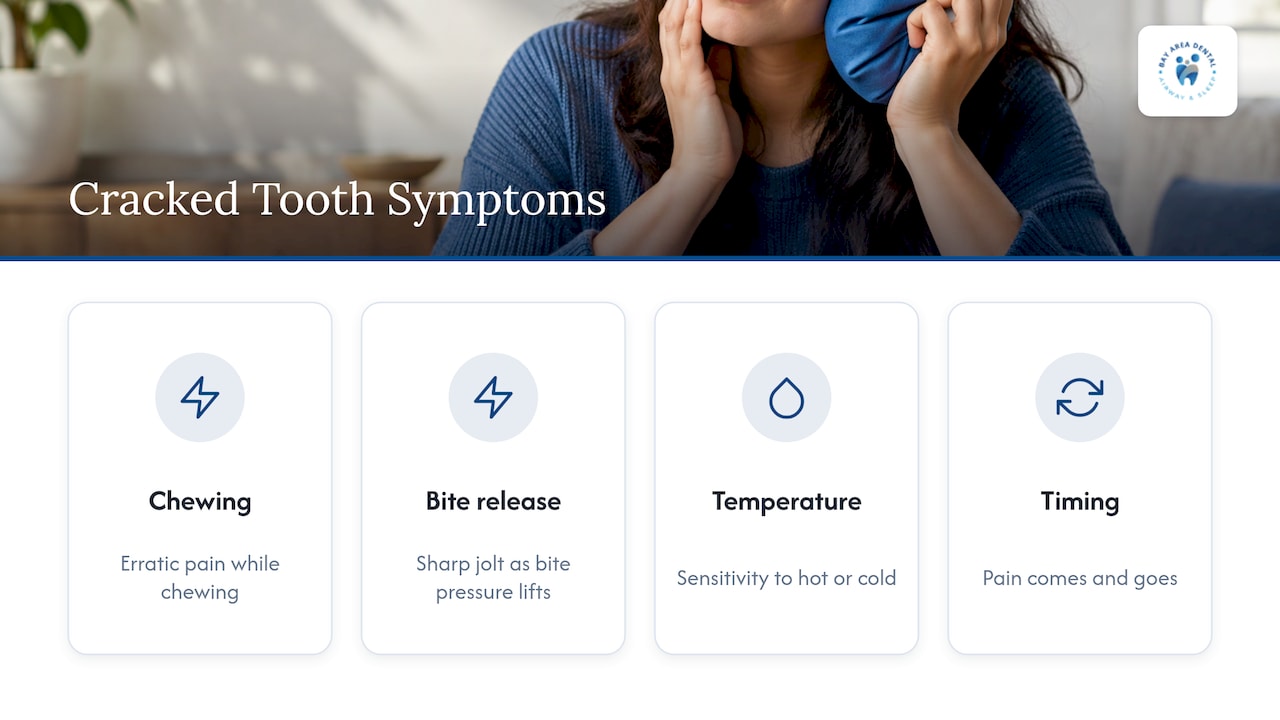
Here is what that looks like day to day.
Pain when you bite, especially when you let go
When you bite on a cracked tooth, the pieces on either side of the crack can flex slightly. That movement reaches the nerve inside the tooth. Many people feel nothing while pressing down and then a sharp jolt when the bite releases. It may happen only with certain foods, such as something crunchy or chewy, or only when you bite at a certain angle.
Sensitivity to hot, cold or sweets
Temperature sensitivity is the second major sign. Delta Dental lists sensitivity to heat or cold alongside pain on biting. A lingering ache after a sip of ice water is a stronger hint than a brief tingle. Either is worth mentioning to your dentist.
Pain that comes and goes
Intermittent pain is typical. You may have a week of discomfort and then three weeks of nothing. That gap does not mean the tooth has recovered. The crack is still there, and chewing can keep working at it.
Subtle signs you might not connect to a crack
- A tooth that feels different when you chew, even without real pain.
- A rough edge your tongue keeps finding.
- Discoloration or a light brown line running vertically through the tooth, which Delta Dental notes can show up on some cracked teeth.
- Gum irritation or swelling near one tooth. A swollen spot on the gum can signal that the nerve inside is in trouble, so have it examined promptly.
- Pain you cannot pinpoint. The AAE notes a dentist may have difficulty locating the tooth causing it, and you may struggle to tell which tooth hurts, too.
Cracks with no symptoms at all
Some cracks are silent. Delta Dental notes that in some cases you may experience hardly any pain. A 2023 review in the British Dental Journal says patients with cracked and fractured teeth may present with no symptoms, pain on biting or release, temperature sensitivity, or spontaneous pain if the pulp is inflamed. No pain is not proof of no crack.
Craze lines vs. a crack: how to tell the difference
If you have ever held your phone flashlight to your teeth and seen fine lines, take a breath. Many adults have them. The AAE explains that craze lines affect only the outer enamel. They are common, shallow and painless, and they are a cosmetic concern rather than a health problem.
A cracked tooth is different. According to the AAE, the crack extends from the chewing surface toward the root and may reach the pulp, the soft tissue with the nerve and blood supply.
| Craze lines | Cracked tooth | |
|---|---|---|
| Depth | Outer enamel only | Enamel and dentin, possibly deeper |
| Pain | None | Often pain on biting or release, and temperature sensitivity |
| Appearance | Many fine, shallow lines, often on several teeth | May be one tooth, sometimes with a visible line or a brown vertical stain |
| Needs treatment | Usually cosmetic only | Yes, evaluation is recommended |
A few practical clues:
- Number of teeth. Fine lines across several teeth, with no symptoms, point toward craze lines. Symptoms in one specific tooth point toward a crack.
- Symptoms. Craze lines do not hurt. If a line comes with biting pain or lingering cold sensitivity, treat it as a possible crack.
- Catch on the nail. A line you can feel with a fingernail or your tongue is more worth checking than one you can only see.
These are only guides. You cannot judge depth from the mirror. A dentist can, and the exam is quick.
Other types of cracks
The AAE describes several patterns, and they matter because they behave differently:
- Infraction: an enamel crack with no loss of tooth structure.
- Fractured cusp: a piece of the chewing surface breaks off, often around a filling. The AAE says this rarely damages the pulp and usually does not cause much pain. A new filling or crown can protect the tooth.
- Cracked tooth: a thin disruption through enamel and dentin, possibly cementum, of unknown depth or extension.
- Vertical root fracture: a crack that begins in the root and extends toward the chewing surface. The AAE says it may show minimal signs and symptoms and go unnoticed for some time. Chewing can move the pieces and irritate the pulp, which may eventually become too damaged to heal itself.
Why cracks are so hard to find
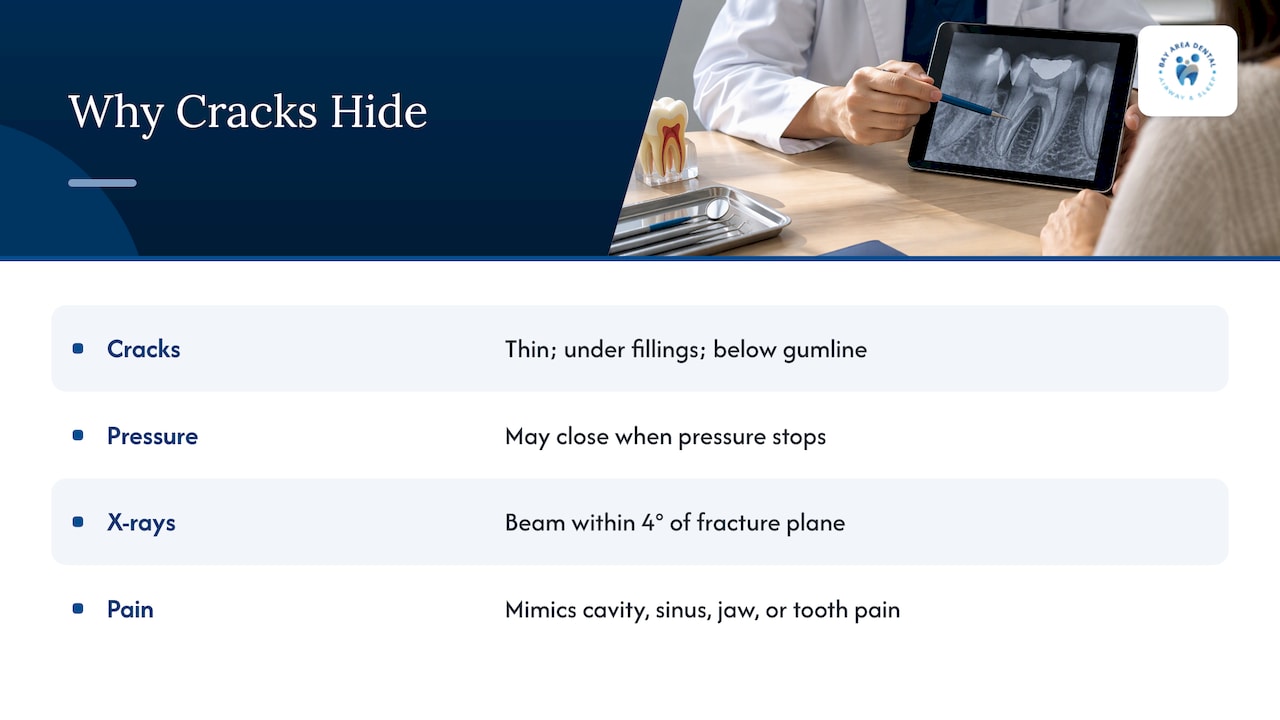
People often say, “My dentist looked and found nothing.” That is common. Cracks are thin, they may sit under a filling or below the gumline, and they can close up when no pressure is applied.
X-rays are part of the problem. The British Dental Journal review notes that two-dimensional radiographs will not directly show a fracture unless the X-ray beam is within four degrees of the plane of the fracture. A clear X-ray does not rule out a crack. If you have concerns about imaging in general, our guide to dental X-ray safety explains what to ask.
Pain can mimic other problems too. Cracked tooth discomfort can feel like a cavity, a sinus problem, jaw joint trouble or pain referred from another tooth, which is why a careful exam matters more than a guess.
How dentists diagnose a cracked tooth
There is no single test. Diagnosis builds from several pieces of information.
- History. The AAE’s 2022 Endodontic Case File Edition says diagnosis begins with dental history and an objective clinical exam. Expect questions about what triggers the pain, how long it lasts and which foods set it off.
- Visual exam with magnification. The same document says current recommendations call for a surgical operating microscope, because the naked eye often misses subtle details. Shining light through the tooth from multiple directions improves visibility.
- Transillumination. StatPearls describes fibreoptic transillumination, where light passes through the tooth until a fracture deflects it, creating a visible line between light and dark.
- Bite testing. StatPearls also describes using a small bite instrument that directs force through one cusp at a time to pinpoint the painful tooth. The British Dental Journal review describes the goal as either seeing the crack directly or, in symptomatic cases, reproducing the symptoms you report.
- Gum probing and imaging. The AAE case file lists signs that are highly suggestive of a crack or fracture, including triggered biting pain, swelling, a sinus tract (a small drainage bump on the gum), a deep narrow probing defect, and visible fractures on X-rays or on small-field 3D scans.
The British Dental Journal review also points out that “cracked tooth syndrome” is an imperfect label, since a crack is a clinical finding rather than a disease. You will still hear the term in the dental office and online, and it means the same pattern of symptoms described above.
When to see a dentist, and how long you can wait
See a dentist as soon as you can if you have symptoms or suspect a crack. The AAE advises exactly this. The practical reasoning is simple: a crack that is caught while it is small gives your dentist more options, while one that reaches the nerve usually needs more involved care.
Book a prompt visit if you notice:
- Pain when biting or releasing a bite.
- New sensitivity to hot or cold in one tooth.
- A chipped tooth, even if it does not hurt.
- Pain that comes and goes without a clear cause.
- A tooth that feels different when you chew.
Get seen the same day or call an emergency line if:
- You have swelling in the gum or face.
- The pain is constant, severe or wakes you at night.
- A large piece of the tooth has broken off.
If you cannot wait for a routine slot, ask about same-day or emergency availability. We cover this through our general and emergency dental care.
What to do until your appointment
The AAE gives specific guidance for the wait:
- If breathing through your mouth or drinking cold fluids is painful, bite on clean, moist gauze or cloth until you reach the dentist.
- Do not use topical oral pain medications or ointments, and do not place aspirin on the affected area.
Beyond that, chew on the opposite side and avoid very hard or sticky foods until the tooth has been checked. For general pain relief, ask your dentist or pharmacist which over-the-counter option suits your health history.
Can a cracked tooth heal on its own?
No. The AAE states plainly that a cracked tooth will not heal like a broken bone. A tooth has no ability to knit the break together, so home remedies cannot fix a crack. Waiting to see if it settles only leaves the crack exposed to chewing forces.
How a cracked tooth is treated
Treatment depends on where the crack is, how deep it goes and whether the nerve is involved. StatPearls says there is no one-size-fits-all approach, as treatment depends on the extent and position of the lesion. Here are the paths you are most likely to hear about.
- Monitoring or cosmetic care for craze lines. If the lines are only in enamel, no dental treatment is needed. If they bother you cosmetically, bonding or veneers are options to discuss.
- A new filling or crown for a fractured cusp. The AAE says a dentist can place a new filling or crown over the damaged tooth to protect it.
- Bonded composite as a splint. StatPearls explains that when there are no signs of pulp involvement, removing the existing restoration and placing a suitable one, such as flowable composite, may be enough. A direct composite acts as an internal splint, keeping the crack from flexing under chewing load and providing immediate symptom relief. If you are weighing filling materials, our comparison of composite vs. amalgam fillings may help.
- More involved care when the pulp is affected. If the crack has irritated the nerve, the AAE notes the pulp may eventually become too damaged to heal itself, and your dentist may refer you for further treatment. The right option depends entirely on the exam findings.
If you like the idea of preserving as much natural tooth as possible, you may also want to read about minimally invasive dentistry and biomimetic dentistry, which explain the thinking behind conservative repairs.
Our perspective
A cracked tooth is one of the clearest examples of why we look at the whole picture instead of just the tooth that hurts. A crack is a finding, and the useful question is what put that much stress on the tooth in the first place.
At our Fremont practice, we focus on root causes rather than only treating symptoms. For a patient with a suspected crack, that means listening closely to when and where the pain happens, examining the tooth and the bite around it, and using advanced tools such as 3D imaging as part of a careful evaluation. We also look at the bigger picture, including how you breathe and sleep, because airway and bite habits can affect how your teeth are loaded.
We favor minimally invasive solutions that protect as much natural tooth as possible, and we explain every option in plain language. We are also committed to accessible care, including for our Deaf patients, so that nobody is left guessing about what is wrong with their tooth or what comes next.
If you have any of the signs above, our advice is simple: do not wait for the pain to settle. Come in and let us find out what is going on.
Bay Area Dental, Airway & Sleep
Get a suspected crack checked in Fremont
If your tooth hurts when you bite, reacts to temperature or just feels different, we can examine it. Our practice offers general, restorative and emergency dental care, along with cosmetic options for teeth that need repair or reshaping, all in one place in Fremont, CA. We treat children and adults, and we welcome Deaf patients with tailored communication.

See our general, restorative and emergency dentistry services, or visit our home page to request an appointment. Parents who suspect a cracked or chipped tooth in a child can start with our pediatric dental care page.
FAQ
How can I tell if my tooth is cracked?
Look for pain when you bite or when you release a bite, sensitivity to hot or cold that comes and goes, and a tooth that feels different when chewing. Sometimes you can see a line or a brown vertical stain. Because cracks are often invisible and silent, only a dental exam can confirm one.
Are craze lines the same as a cracked tooth?
No. Craze lines are shallow lines in the outer enamel that are common, painless and cosmetic, according to the AAE. A cracked tooth extends from the chewing surface toward the root and may reach the nerve. If a line comes with biting pain or lingering sensitivity, have it examined.
How long can I go with a cracked tooth?
There is no safe timeline, because a crack will not heal and chewing can keep working at it. The AAE advises seeing a dentist as soon as possible when you have symptoms or suspect a crack. Go the same day if you have swelling or severe, constant pain.
Can a cracked tooth be fixed naturally at home?
No. The AAE states that a cracked tooth will not heal like a broken bone. Until you see a dentist, bite on clean, moist gauze if cold air or drinks hurt, and avoid topical numbing products and aspirin placed on the tooth.
Why didn’t my X-ray show the crack?
Flat X-rays often miss cracks. The British Dental Journal review notes they show a fracture directly only when the beam is within four degrees of the crack’s plane. Dentists rely on history, magnified visual exams, bite tests and light transillumination, and sometimes advanced imaging, to find them.
Sources
- Cracked Teeth, American Association of Endodontists
- Cracked tooth: symptoms and diagnosis, Delta Dental
- Top tips for managing enamel infractions, cracks and fractures, British Dental Journal (2023)
- Endodontic Case File Edition 2022, American Association of Endodontists
- Cracked Tooth Syndrome, StatPearls, NCBI Bookshelf (2024)