

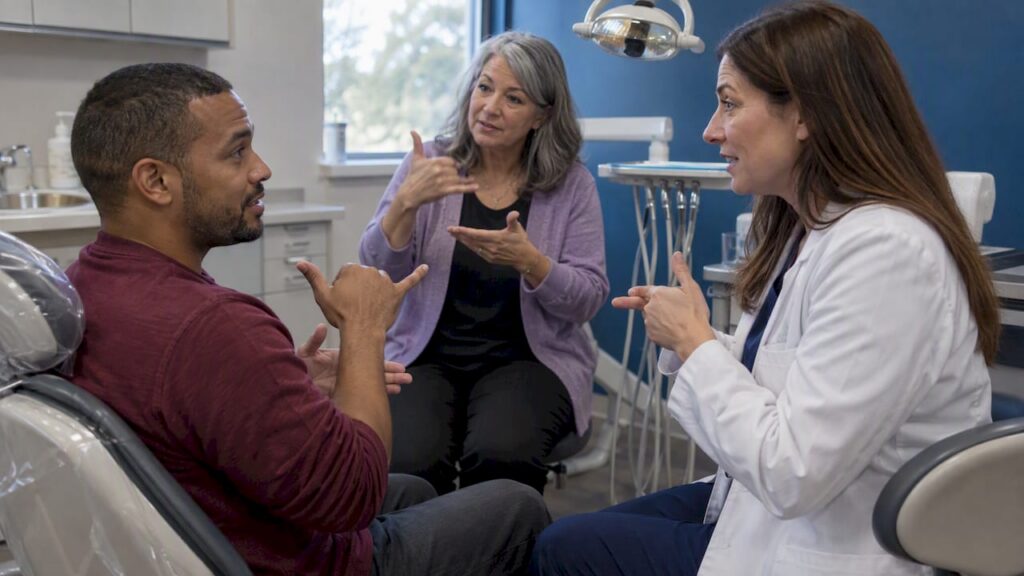
If you are Deaf or hard of hearing, a U.S. dental or medical office must communicate with you effectively, and that usually means providing the aid or service you need at no cost to you. Under the Americans with Disabilities Act (ADA), this can be a qualified sign language interpreter, captioning, written materials or another tool, chosen with your input. This guide explains what the rules say, how to ask, when a relative may step in, and what to do if an office says no.
TL;DR
- The ADA requires covered providers to communicate effectively with patients who are Deaf or hard of hearing and to supply auxiliary aids and services when needed. ADA.gov states the rule.
- The duty covers private dental practices of any size, and the practice pays for the aid. You cannot be charged, even if your insurance does not cover it.
- Tell the office early what you need. Interpreters matter most for long or complex conversations such as consent, diagnoses and procedures.
- A family member or child should not be your default interpreter. Narrow exceptions exist.
- If an office refuses, you can file a complaint. Document the request and the response first.
Table of Contents
- What the law says about effective communication
- What counts as an auxiliary aid or service
- How the right aid is chosen
- Who pays, and what about family members
- Phone calls, scheduling and the front desk
- How to ask for what you need
- If an office refuses or the communication fails
- Our perspective
- Care in Fremont built around clear communication
- Practical checklist for your next visit
- FAQ
- Sources
What the law says about effective communication
The ADA requires covered entities to communicate effectively with people who have communication disabilities and to provide auxiliary aids and services when needed, according to the U.S. Department of Justice. The Department describes the goal as an experience that is equally effective to the one people without disabilities get. That standard is the useful one to keep in mind. The question is not whether the office tried something. It is whether you understood your diagnosis, your options and your instructions as well as any other patient would.
The duty is not limited to hospitals. The National Association of the Deaf (NAD) explains that it applies to all private healthcare providers, including private dental practices, regardless of office size or number of employees. A one-dentist office in a strip mall is covered, just as a large clinic is.
The protection also reaches beyond the patient. The ADA’s effective communication rules apply to parents, spouses or companions who have communication disabilities in appropriate circumstances. If you are a Deaf parent bringing a hearing child to a pediatric visit, you are part of that conversation and the office must communicate with you effectively too.
A second federal law adds weight. The American Dental Association notes that under Section 1557 of the Affordable Care Act, providing auxiliary aids is a matter of equal opportunity to participate in and benefit from dental care. It also says these aids and services must be provided in a timely manner and in a way that protects your privacy and independence.
What counts as an auxiliary aid or service
“Auxiliary aid” sounds abstract, but the list is practical. The U.S. Department of Health and Human Services lists qualified interpreters, notetakers, transcription services, written materials, assistive listening devices, captioning and TTYs among the options.
Which one fits depends on you and on the visit:
| Situation | Aid that often fits |
|---|---|
| Signing patient, consent for a procedure | Qualified in-person sign language interpreter |
| Hard of hearing, comfortable with speech | Assistive listening device, captioning, face-to-face speech without a mask where possible |
| Routine cleaning, simple instructions | Written notes, or an interpreter if you prefer one |
| Phone scheduling and reminders | TTY or an equally effective telecommunication system, text or email if you choose it |
| Complex diagnosis or treatment planning | Interpreter or real-time captioning, plus written summary |
This table is an illustration, not a rulebook. The Department of Justice says providers must consider the nature, length, complexity and context of the communication and your normal methods of communication. A signing patient who is happy with notes for a cleaning might still need an interpreter for a root canal discussion.
How the right aid is chosen
You are not supposed to be handed whatever is convenient. NAD advises that providers consult with the patient and carefully consider the patient’s self-assessed communication needs before choosing an aid or service. The Hawaii Department of Health makes the same point in its provider guidance, describing an interactive, consultative process rather than a unilateral decision by the office.
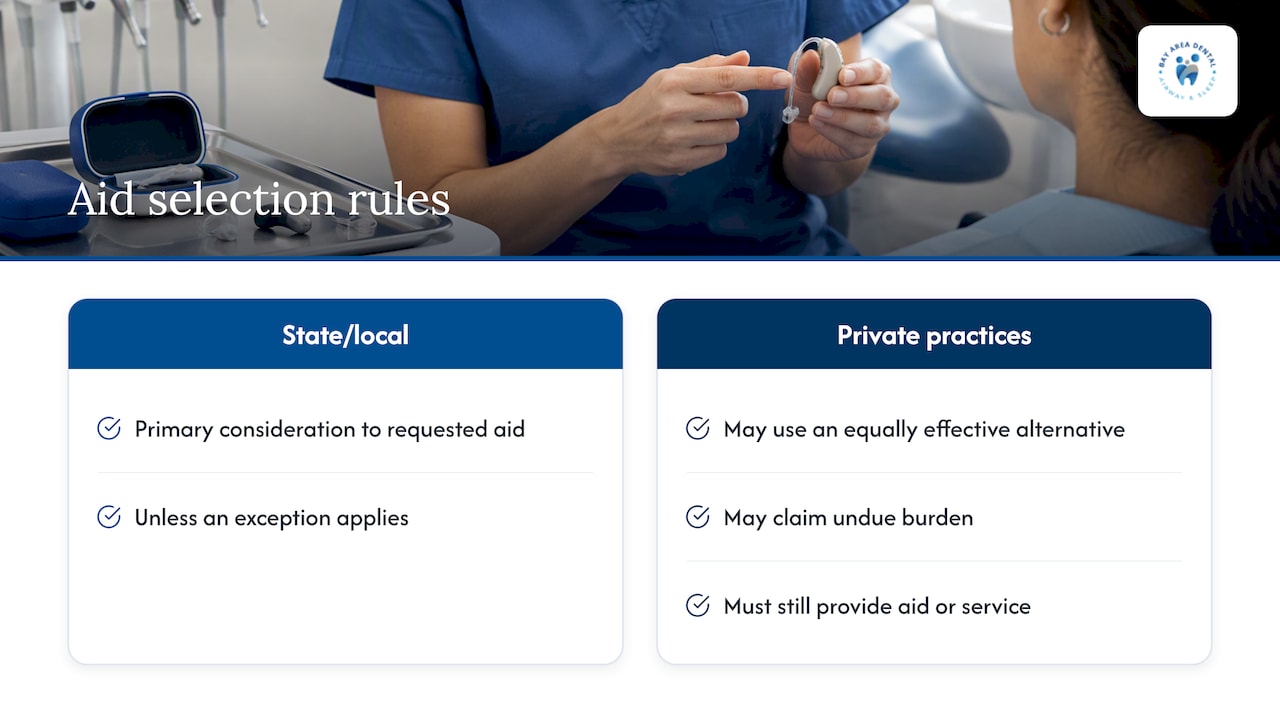
For state and local government entities, the rules go further and require primary consideration to the aid you request, unless an exception applies. Private practices have a bit more flexibility. As one ADA technical assistance center explains, a private business may use another method if it is equally effective or if yours would be an undue burden, but it must still provide an aid or service. In other words, “we can’t do that” never ends the conversation. It starts a search for an alternative that works.
If you want help putting your preferences into words before a visit, a guide on telling your provider how you communicate can help you plan what to say, even though its examples come from a different kind of care.
When an interpreter is the right answer
NAD says an interpreter should be present when the exchange is lengthy or complex enough to require one. Its examples include medical histories, informed consent, diagnoses, treatment and major procedures. For dental care, think of:
- A new-patient visit where your health history is taken.
- A treatment plan discussion with several options and costs.
- Consent for extractions, implants, sedation, or surgery.
- Post-procedure instructions you will follow at home.
A note on video remote interpreting
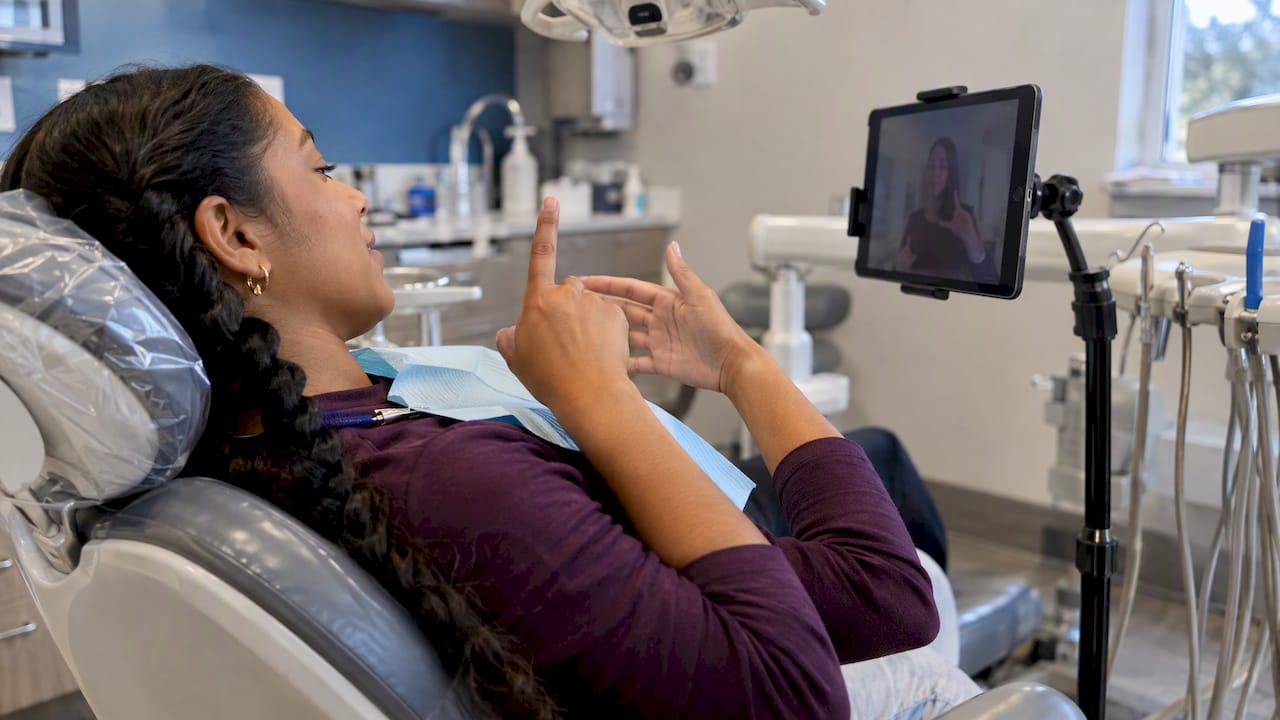
Video remote interpreting (VRI) is common in offices that cannot book someone in person. Hawaii’s guidance says VRI does not replace the high standard of on-site interpretation and must be assessed against your communication mode, needs, preferences and the situation. If you sign and the video freezes, or if your hands are busy, or you cannot see the screen while reclined in a dental chair, say so. Ask for another option.
Who pays, and what about family members
The practice pays. Under the Hawaii Department of Health’s guidance, providers must cover the cost of communication aids, may not charge the patient, and may not refuse service because insurance does not cover those costs. The American Dental Association likewise says covered dental practices must provide required interpreting services free of charge.
What about your spouse, your teenager or a friend? The ADA’s guidance for dentists says a practice may rely on an accompanying adult only in two cases: an emergency involving an imminent threat when no interpreter is available, or when you specifically request it, the adult agrees, and relying on them is appropriate. A minor child may interpret only in that kind of emergency.
There are good reasons for the limits. A relative may not know dental vocabulary, may soften bad news, and should not be placed in the middle of your private health information. If you would rather bring someone you trust, that is your choice to make, and you can put it in writing. It should never be the office’s workaround for a missing interpreter.
Phone calls, scheduling and the front desk
Access starts before you sit in the chair. For phone communication, the American Dental Association says dental practices must use TTYs or equally effective telecommunication systems for patients who are Deaf or hard of hearing. In practice, many patients prefer text, email or an online form. Ask whether the office will confirm appointments and send reminders in the way you choose.
The Hawaii guidance recommends that practices formally train staff and write internal policies so compliance does not depend on who answers the phone. A good sign is an office that knows how it books interpreters and does not need to improvise.
How to ask for what you need
HHS advises that you let the entity know as soon as possible that you are deaf or hard of hearing and ask for the aid or service you think you need. Interpreters often have to be scheduled ahead, so earlier is easier for everyone. A disability rights group in North Carolina suggests calling at least a week before the appointment when you can, which is a sensible rule of thumb.
A simple script works:
- Say you are Deaf or hard of hearing and how you communicate (ASL, speech with captioning, written English).
- Name the aid you want for this visit, for example an in-person ASL interpreter.
- Ask how the office will confirm it, and how you will be told if the interpreter cancels.
- Put it in an email or text so there is a record.
- Ask what happens for follow-up visits so you do not have to repeat yourself.
For more on choosing a dentist and what to ask on a first call, see our guide to Deaf dental care, your rights and options and our explainer on when dentists must provide free ASL interpreters.
If an office refuses or the communication fails
Start with the office itself. Ask for the practice manager or owner, restate your request, and cite the ADA. A written request and a written reply give you a paper trail. The North Carolina advocacy guide suggests a follow-up letter and a call a few days later, and notes that you may also file a complaint with the U.S. Department of Justice, which enforces the ADA. The Department’s ADA Information Line, listed in that guide, is (800) 514-0301.
NAD maintains a page on how to file a complaint when a business or service provider fails to provide accommodations. Before you file, gather:
- The date, the office name and who you spoke with.
- Your request, in writing if possible.
- The response, including any refusal, cost demand or offer of a family member as interpreter.
- What happened as a result: a rescheduled visit, a procedure you did not understand, a bill.
If you want advice on your specific situation, a disability rights organization in your state, a legal aid office or an attorney who handles ADA matters can help. Laws also differ by state, so ask about protections in the state where you live, in addition to the federal rules above.
Our perspective
We built our practice around the idea that dental care should address the whole person, and that starts with understanding each other. For Deaf patients, communication is not an extra. It is how consent, diagnosis and trust happen.
In our experience, the best visits begin before the appointment: asking how you prefer to communicate, planning the aid with you and making sure you leave knowing what was done and what comes next. We are committed to tailored communication and education for Deaf patients because a treatment plan you cannot fully follow is not good care.
That approach fits how we practice more broadly. We focus on root causes, use minimally invasive technology such as 3D imaging and lasers, and offer airway, restorative, cosmetic and pediatric care under one roof. When you can ask questions and get clear answers, you make better decisions about all of it.
Bay Area Dental, Airway & Sleep
Care in Fremont built around clear communication
If you are looking for a dentist in the Fremont area, we welcome Deaf and hard-of-hearing patients, and we want to hear how you prefer to communicate before your first visit. Our services include general and preventive care, restorative and cosmetic dentistry, orthodontics, airway and sleep dentistry, myofunctional therapy and care for children.
Tell us what you need when you book, and see our general dentistry services or contact the practice through our home page to get started. Families can also read about pediatric dental care.
Practical checklist for your next visit
Before the appointment
- Request your aid in writing and keep the reply.
- Ask how the office will handle phone or text contact.
- Confirm whether the interpreter will be in person or by video and ask for in-person for anything complex.
At the appointment
- Check that the interpreter is qualified and that you can see them comfortably from the chair.
- Ask the dentist to explain before starting, since you may not be able to follow once a mask is on or you are reclined.
- Ask for a written summary of the treatment plan and aftercare.
After the appointment
- Note anything you did not understand and call or message the office.
- Confirm you were not billed for the interpreter.
- Tell the office what worked so it is repeated next time.
FAQ
Does a small dental office have to provide a sign language interpreter?
Yes, in most cases. NAD explains that the duty applies to private healthcare providers, including dental practices, regardless of size or number of employees. The practice can use another method only if it is equally effective, or if your preferred one would be an undue burden, and even then it must still provide some auxiliary aid or service.
Can the dentist make me pay for the interpreter?
No. Covered dental practices must provide required interpreting services free of charge, and Hawaii’s provider guidance adds that an office may not refuse service because your insurance does not cover the aid. If you receive a bill for the interpreter, dispute it in writing and ask for it to be removed.
Can my child or spouse interpret instead?
Only in narrow cases. The ADA’s dental guidance allows reliance on an accompanying adult in an emergency with an imminent threat when no interpreter is available, or when you request it and the adult agrees and it is appropriate. A minor child may interpret only in that kind of emergency. Routine visits do not qualify.
Is video interpreting enough?
Sometimes, but not always. Hawaii’s guidance says VRI does not replace the standard of on-site interpreting and should be judged by your needs and preferences. If the connection is poor, or the setup does not work in a dental chair, you can ask for a different option.
Where do I complain if my request is denied?
Start with the practice manager, then consider a complaint to the U.S. Department of Justice, which enforces the ADA. NAD’s complaint page explains the process, and the ADA Information Line at (800) 514-0301 can answer questions. Keep your written request and the office’s response.
Sources
- ADA Requirements: Effective Communication, ADA.gov
- Communicating Effectively with People with Disabilities, ADA.gov
- Questions and Answers for Health Care Providers, National Association of the Deaf
- Section 1557 Auxiliary Aids and Services, American Dental Association
- Effective Communication for Persons Who Are Deaf or Hard of Hearing, HHS
- Guidance for Health Care Providers in Ensuring Effective Communication, Hawaii Department of Health
- Communication responsibilities for private and public organizations, ADA Pacific
- Sign Language Interpreters in Healthcare, Disability Rights NC
- How to File a Complaint, National Association of the Deaf